What Is Breathwork? Types, How It Works and What It Feels Like
By Oliver Glozik · · updated
What is breathwork? Breathwork is any practice where you change the way you breathe on purpose to change how you feel, in your body and in your mind. The first thing we do when we come into this world is an inhale, and the last thing we do when we leave it is an exhale. In between, we breathe thousands of times a day, and almost all of it happens without us noticing. Breathwork is what happens when you put conscious attention on it. Some types of breathwork can help you calm down within a minute. Others are guided sessions of half an hour or more that can release emotions you have been holding for a long time. Every one of them uses a tool you always have with you.
Breathwork at a glance
- The definition: changing how you breathe on purpose to change how you feel.
- The roots: pranayama in yoga. The modern word comes from Western methods of the 1970s.
- The two directions: slow breathing calms the nervous system, fast breathing activates it and can release emotions.
- The evidence: a small to medium effect on stress, in a field that is still young.
- The safety rule: active release breathwork is not for everyone, so check the safety list first.
- The key to results: doing it regularly matters more than one big session.
What is breathwork? A simple definition
The meaning of breathwork, also written breath work, is simple. Breathwork is an umbrella term for breathing techniques used to change your physical, mental or emotional state. It covers very different things: a slow breathing pattern to fall asleep, a short exercise to focus before a meeting, the yogic breathing of pranayama, and long, intense sessions where people cry, shake or laugh.
What connects them is that breathing is one of the few body functions that runs on autopilot and that you can also steer whenever you want. You can’t tell your heart to slow down or your stomach to digest faster. You can change your breath, and by changing your breath, you also change the signals your body sends to your brain.
Where breathwork comes from
The oldest form of breathwork is pranayama, the breathing practice of yoga. The word combines the Sanskrit prana, breath or life force, with ayama, extension or control. Pranayama is one of the eight limbs of yoga in the Yoga Sutras of Patanjali, a text that is more than 1,500 years old. Later yoga manuals like the 15th-century Hatha Yoga Pradipika describe many techniques in detail, including long breath holds.
The word “breathwork” itself comes from the West, from the 1970s:
- Rebirthing. In the United States, Leonard Orr developed a method of continuous breathing with no pause between the inhale and the exhale. This connected breathing is the root of what most people today call conscious connected breathwork.
- Holotropic Breathwork. The psychiatrist Stanislav Grof had researched LSD therapy. When that research became impossible, he and his wife Christina Grof developed a way to reach similar non-ordinary states without a substance, with fast, deep breathing, loud evocative music and bodywork.
- Newer methods. Later came methods like the Wim Hof Method, which combines rounds of deep breathing and breath holds with cold exposure, and many schools that mix these elements.
So when someone says “breathwork” today, it can mean a centuries-old yogic technique or a session with a playlist on Zoom. It helps to ask which type they mean.
How does breathwork work and what does it do?
Breathwork works because your breath and your emotional state are connected in both directions. Every emotional state has its own breathing pattern. You breathe differently when you are angry than when you are at peace, and differently again when you are anxious. A study from 1991 found that people who produced six basic emotions, like joy, anger and fear, each showed a clearly different breathing pattern (Bloch et al., 1991).
“The easiest way to change our emotional state is by changing our breathing pattern. Something we always have access to. The biggest portal we rarely consciously use.”
 Oliver GlozikBreathwork facilitator, hypnotist and coach
It also works the other way around. When you change the breath, you change the state. There are two main directions.
Slow breathing: the rest and repair system
Slow breathing moves you into the parasympathetic nervous system, the rest and repair mode of the body. A review of 15 studies on breathing slower than 10 breaths a minute found higher heart rate variability, a sign of a relaxed nervous system, together with more comfort and relaxation and less anxiety (Zaccaro et al., 2018). The authors also say the evidence base is small and the exact mechanism is still debated.
One leading idea is that a long, slow exhale stimulates the vagus nerve, the main nerve of the rest and repair system (Gerritsen & Band, 2018). This is a model, not a proven fact, but it fits what people feel. A long exhale calms you down.
Fast breathing: activation and release
Fast, deep breathing does the opposite and activates the body. When you breathe faster and deeper than your body needs, you breathe out more carbon dioxide than it produces. Your blood becomes slightly more alkaline, which doctors call respiratory alkalosis. That is what causes the typical sensations of active breathwork: tingling in the hands and face, light-headedness, changes in temperature and sometimes cramping in the hands (MSD Manual). In breathwork circles the cramped hands are called “lobster claws”. They are uncomfortable but they pass once you go back to normal breathing.
This activation is measurable. In a Dutch study, 12 men trained in a Wim Hof-style programme of fast breathing, breath holds, cold exposure and meditation released more adrenaline during the practice than an untrained group (Kox et al., 2014). It was a small study with only men, so it shows that the effect is real, not how far it goes.
In conscious connected breathwork there is also something less physical happening. You keep on breathing in a certain rhythm and that gives your conscious mind something to do. Eventually the rhythm takes over, and through that your state shifts. For many people this is the first time the thinking mind steps back.
Types of breathwork
There are two kinds of breathwork: short techniques you use for a few minutes to change your state, and longer guided sessions for deeper emotional work. Both are breathwork, but they do very different jobs.
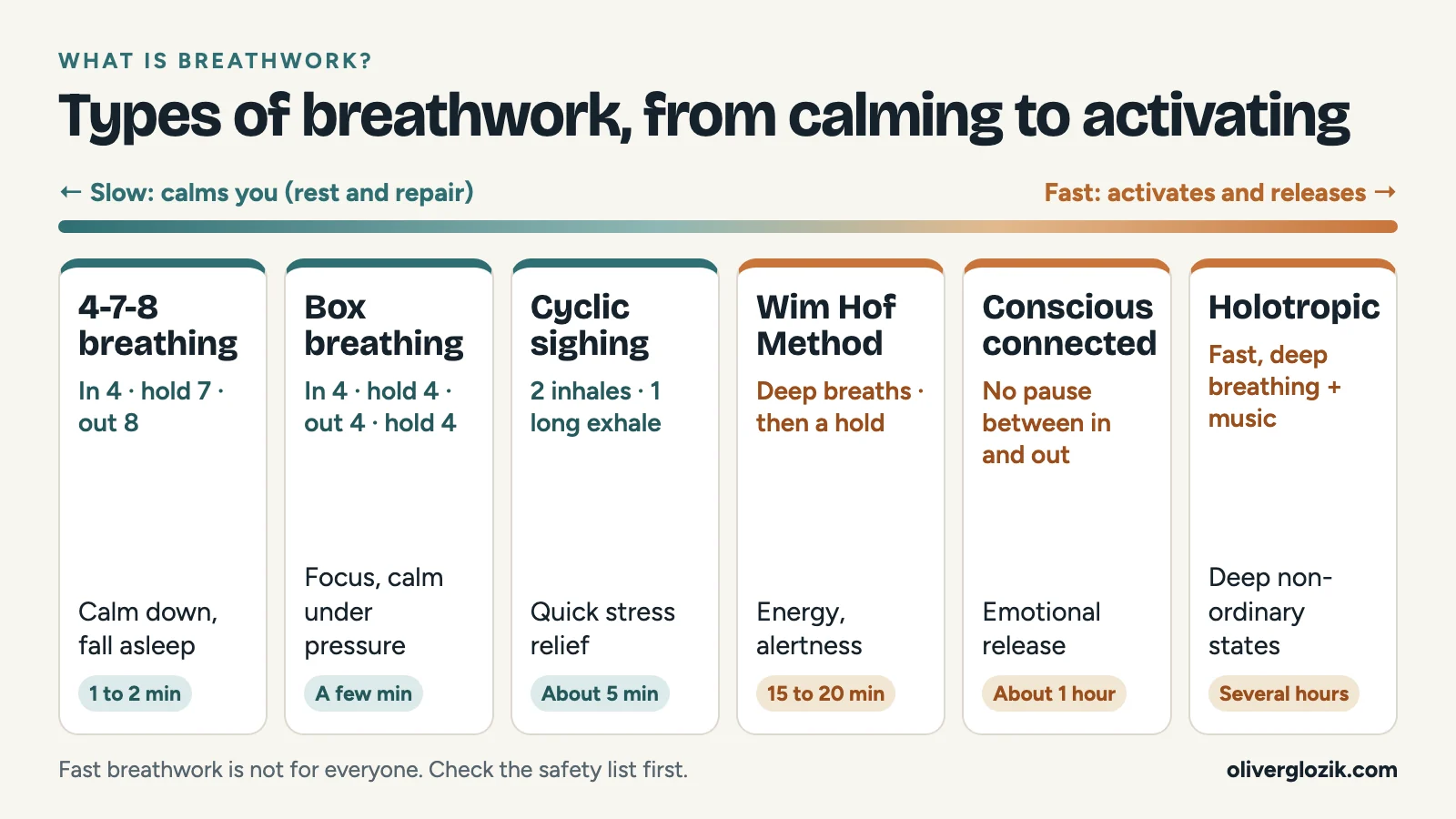
| Type | How you breathe | What people use it for | How long |
|---|---|---|---|
| 4-7-8 breathing | Inhale for 4 seconds, hold for 7, exhale for 8 | Calming down, falling asleep | A few rounds, 1 to 2 minutes |
| Box breathing | Inhale for 4, hold for 4, exhale for 4, hold for 4 | Focus, staying calm under pressure | A few minutes |
| Cyclic sighing | Two inhales through the nose, one long exhale through the mouth | Quick stress relief | About 5 minutes |
| Pranayama | Yogic techniques like alternate nostril breathing or fast belly pumping | Part of a yoga practice, energy, calm | 5 to 30 minutes |
| Wim Hof Method | Rounds of deep breaths followed by a breath hold, often with cold exposure | Energy, alertness | 15 to 20 minutes |
| Conscious connected breathwork | Continuous breathing with no pause between inhale and exhale | Emotional release | 30 minutes of active breathing, about an hour in total |
| Holotropic Breathwork | Fast, deep breathing with loud music, in pairs | Deep non-ordinary states | Several hours |
Somatic breathwork is a name you will also see a lot. It is less one fixed technique and more a way of working: breathwork that puts the attention on sensations and stored tension in the body. What it means in practice depends on the facilitator.
The techniques I use myself
My favourite technique for myself is 4-7-8 breathing, which was popularised by the American doctor Andrew Weil. You inhale for four seconds, hold for seven and exhale for eight. Inhaling for four is easy. Holding for seven is okay. Then the exhale is eight seconds. Compared to the short inhale there is a long hold and a long exhale, and I like that there is a level of challenge in it. By slowing the breath down to that degree, it calms the nerves and it brings you into the present moment. For calming down, I think 4-7-8 is great.
For concentration I use box breathing: inhale for four, hold for four, exhale for four, hold for four. If a breath hold makes you dizzy, shorten it, and always do these sitting or lying down.
What a guided breathwork session looks like
A guided conscious connected session has five parts: an explanation, a grounding phase, about 30 minutes of active breathing, a calm phase to let it settle, and a short sharing circle. This is how I run my sessions after my breathwork certification.
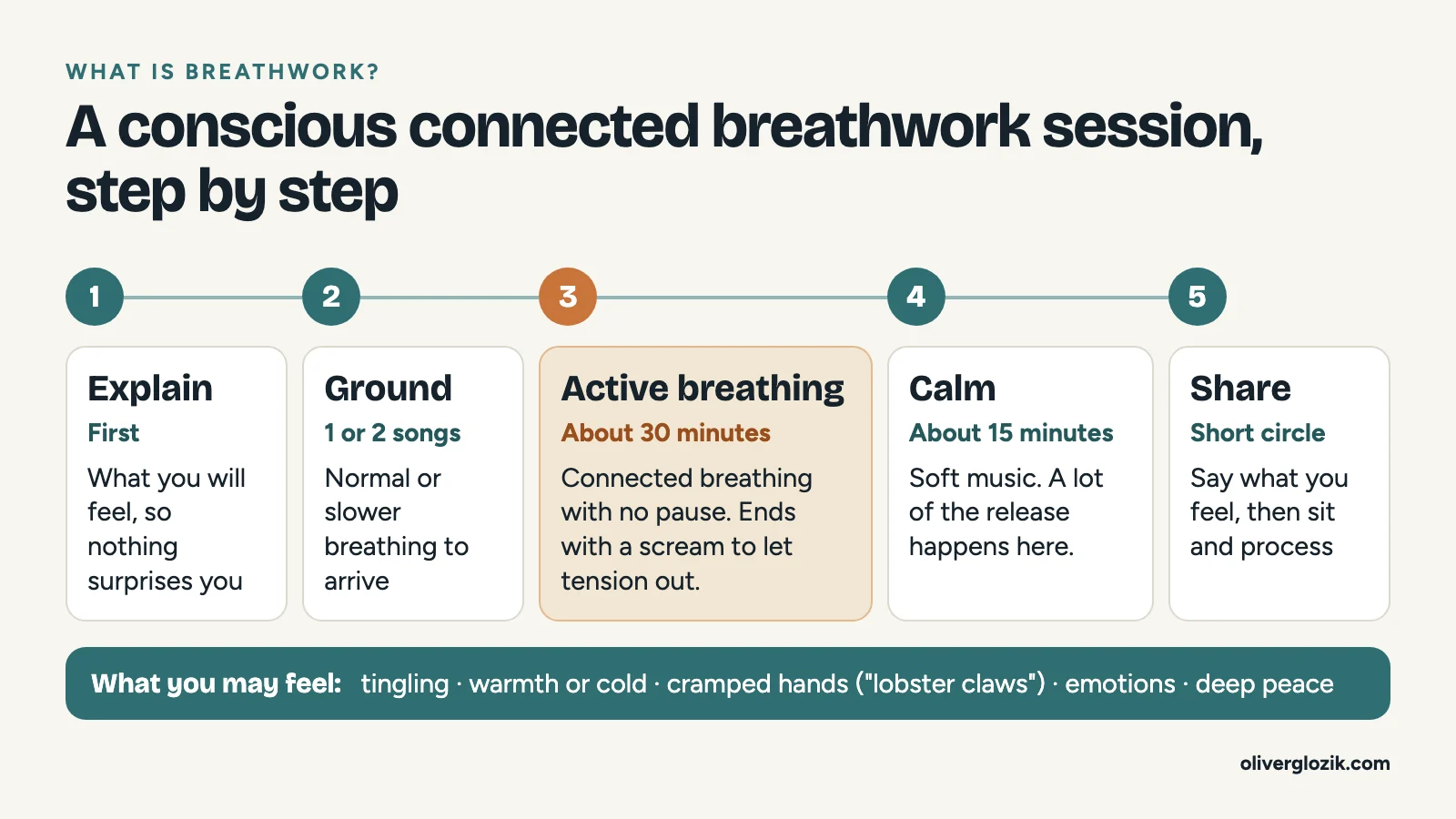
First, I explain what will happen. There are a lot of changes in the body during the session, the temperature changes, the tingling, the lobster claws. It is very important that people know what to expect, so nothing surprises them.
Then we ground. For the first song or two, people breathe normally or even slower than normal. This gets them grounded and ready for the active part.
Then the active breathing, about 30 minutes. I like 30 minutes because it gives a level of emotional release without it going crazy. You can go deep, but it is less about “how deep can I go” and more about what is ready to come up. At the end of the active part there is a scream, where people can release the tension.
Then about 15 minutes of soft music. A lot of the release actually happens here, in the 10 to 15 minutes after the active breathing, because now people are in that calm state. People also say it is the first time they have felt peace in such a long time.
Last, a short sharing circle. Everyone can say what they feel, and I get an idea of where the group is. I keep it short on purpose. In that moment it is less about talking and more about sitting and processing.
If I notice someone going too deep, I come closer, tell them to slow their breathing down, and with a grounded presence bring them back to themselves. Because people are briefed well and the active part is 30 minutes, it is rare that anyone panics.
How I found breathwork
I first heard about breathwork on the Joe Rogan podcast, especially that it can release strong emotional states. I knew there was something powerful in it, but I didn’t have access to it. I didn’t know anybody who did it. Then an old football coach I knew started doing breathwork sessions online, and I joined one. It opened me up very emotionally. I was able to feel my emotions, and I felt so much better after.
Before that I had been meditating, and meditation was very difficult for me, as it is for many people. If you have a Western overthinking mind and you close your eyes, in a way you get even more overthinking. With breathwork I didn’t have to fight my thoughts. The breath gave my mind a job, and after a while the rhythm took over. So for some people, breathwork can be an alternative to meditation.
I’m always looking for tools that helped me on my own journey, so I can offer them to the people who come to me. That’s how I came to do my breathwork certification.
What the research says about breathwork
Research shows that breathwork can reduce stress, with a small to medium effect, but the field is still young. The biggest review so far pooled 12 randomised controlled trials with 785 adults and found less stress after breathwork than in the control groups, and similar small to medium effects on anxiety and depression (Fincham et al., 2023).
The same review is honest about the limits. Most of the studies had some risk of bias, and the authors warn against hype that runs ahead of the evidence. Only two of the stress studies tested fast breathing, too few to say much, and the authors say the safety of fast-paced breathwork needs more research.
Some of the clearest results come from short, slow practices. In a one-month study at Stanford, five minutes a day of cyclic sighing improved mood more than five minutes of mindfulness meditation (Balban et al., 2023).
The emotional release people describe after conscious connected sessions has not been studied well yet. I’d rather say that clearly than pretend the science is further than it is.
Who should be careful with breathwork
Slow breathing techniques are safe for most people. The deep, fast release work is intense and is not for everyone.
Don’t do active breathwork like conscious connected or holotropic breathing if you:
- are pregnant
- have a heart condition or high blood pressure
- have epilepsy
- have glaucoma or a detached retina
- have had recent surgery
- have a history of psychosis or bipolar disorder
If you take medication for your heart, blood pressure, seizures or mental health, check with your doctor first. Never practise fast breathing or breath holds in water or while driving, because you can get light-headed or even pass out. Breathwork can support you, but it does not replace medical or psychological care. If you are in crisis, contact your local emergency services.
Why consistency matters more than one big session
The biggest strength of breathwork is that it is always available and the results come from doing it regularly. A retreat is a beautiful thing, but it is also a big commitment of time, travel, money and energy. Your breath is with you every day, and you can do a session every week from the comfort of your home.
It is the same with every technique. If you use 4-7-8 breathing once in your life and it works, and then you never use it again, you get a limited benefit. It is the same with conscious connected breathwork. One or two sessions can do a lot. When you keep coming back to it, it becomes a tool to keep releasing the emotional tension that we all build up over time. So breathwork is less about one big experience and more about a practice you return to.
Breathwork for beginners: how to start
The easiest way to start breathwork is with one slow technique for two to five minutes a day.
- Pick one technique for one need. 4-7-8 breathing in the evening to calm down, or box breathing before work to focus.
- Do it at the same time every day for two weeks, so it becomes a habit and not a one-time trick.
- Try a guided session for the deeper work. Conscious connected breathwork is best done the first time with a facilitator who explains what will happen and watches the room.
- Tell your facilitator about your health. A good facilitator will ask you about the conditions in the safety list above before you start.
If you want to try it with me, see how my breathwork sessions work.
Questions about breathwork
What does breathwork feel like?
Slow techniques feel calming and grounding. Active breathwork can bring tingling, warmth or cold, cramped hands and strong emotions, followed by a deep calm.
Is breathwork the same as pranayama?
Pranayama is the yogic form of breathwork. Breathwork is the wider term that also includes modern methods like conscious connected breathing and the Wim Hof Method.
Why do my hands tingle during breathwork?
Breathing fast and deep lowers the carbon dioxide in your blood, which makes nerves and muscles more excitable. It passes when you return to normal breathing.
How long is a breathwork session?
A simple technique takes one to five minutes. My conscious connected sessions are about an hour, with 30 minutes of active breathing.
Can I do breathwork at home?
Yes. Slow techniques are made for home use, and many people join guided sessions online. Do your first deep session with a facilitator.
What is the difference between breathwork and hypnosis?
Both quiet the thinking mind. In breathwork your subconscious brings up what is most present, while in hypnosis the hypnotist guides you to a specific topic.
References
- Bloch, S., Lemeignan, M. & Aguilera-T, N. (1991). Specific respiratory patterns distinguish among human basic emotions. International Journal of Psychophysiology, 11(2), 141 to 154. https://doi.org/10.1016/0167-8760(91)90006-J
- Zaccaro, A., Piarulli, A., Laurino, M. et al. (2018). How breath-control can change your life: a systematic review on psycho-physiological correlates of slow breathing. Frontiers in Human Neuroscience, 12, 353. https://doi.org/10.3389/fnhum.2018.00353
- Gerritsen, R. J. S. & Band, G. P. H. (2018). Breath of life: the respiratory vagal stimulation model of contemplative activity. Frontiers in Human Neuroscience, 12, 397. https://doi.org/10.3389/fnhum.2018.00397
- MSD Manual Professional Version. Respiratory alkalosis. https://www.msdmanuals.com/professional/endocrine-and-metabolic-disorders/acid-base-regulation-and-disorders/respiratory-alkalosis
- Kox, M., van Eijk, L. T., Zwaag, J. et al. (2014). Voluntary activation of the sympathetic nervous system and attenuation of the innate immune response in humans. PNAS, 111(20), 7379 to 7384. https://doi.org/10.1073/pnas.1322174111
- Fincham, G. W., Strauss, C., Montero-Marin, J. & Cavanagh, K. (2023). Effect of breathwork on stress and mental health: a meta-analysis of randomised-controlled trials. Scientific Reports, 13, 432. https://doi.org/10.1038/s41598-022-27247-y
- Balban, M. Y., Neri, E., Kogon, M. M. et al. (2023). Brief structured respiration practices enhance mood and reduce physiological arousal. Cell Reports Medicine, 4(1), 100895. https://doi.org/10.1016/j.xcrm.2022.100895
Want to try it for yourself?
See how my breathwork sessions work, or book a free call and ask me anything first.