What Is the 4-7-8 Breathing Technique? How to Do It and Why It Calms You
By Oliver Glozik ·
What is the 4-7-8 breathing technique? 4-7-8 breathing is a slow breathing pattern where you inhale through your nose for a count of four, hold your breath for a count of seven and exhale through your mouth for a count of eight. You repeat that four times, and it takes about a minute. The long hold and the even longer exhale slow your whole system down, and having to count gives your mind something to hold on to, so it stops racing. The American doctor Andrew Weil made it popular, and today it is one of the most taught breathing techniques in the world. It is one of my personal favourites for calming down and getting present, and in this post I explain how to do it, why it works, what the research really shows and the mistake almost every beginner makes.
4-7-8 breathing at a glance
- The pattern: inhale through the nose for 4, hold for 7, exhale through the mouth for 8.
- How long: four rounds, about a minute. Twice a day, building up to eight rounds after a month.
- What it is for: calming down, nervousness before something important, winding down at night.
- Why it works: the breath slows to about three breaths a minute, with an exhale twice as long as the inhale.
- The research: small studies show a lower heart rate and less anxiety, but there are no big trials yet.
- The beginner mistake: breathing out too fast, so there is no air left for the count of eight.
How to do 4-7-8 breathing, step by step
Sit or lie down, put the tip of your tongue behind your upper front teeth, and breathe in for 4, hold for 7 and out for 8. These are the steps as Dr Weil teaches them, and as I learned them in my breathwork certification.
- Get comfortable. Sit with your back supported or lie down. Never do this while driving or standing somewhere you could fall.
- Place your tongue. Rest the tip of your tongue on the ridge of tissue just behind your upper front teeth, and keep it there for the whole exercise.
- Empty your lungs. Breathe all the air out through your mouth with a soft whoosh sound.
- Inhale for 4. Close your mouth and breathe in quietly and smoothly through your nose for a count of four.
- Hold for 7. Hold your breath for a count of seven. Comfortably, not with force.
- Exhale for 8. Breathe out through your mouth with that soft whoosh for a count of eight, until your lungs are empty.
- Repeat three more times, so you do four breaths in total.
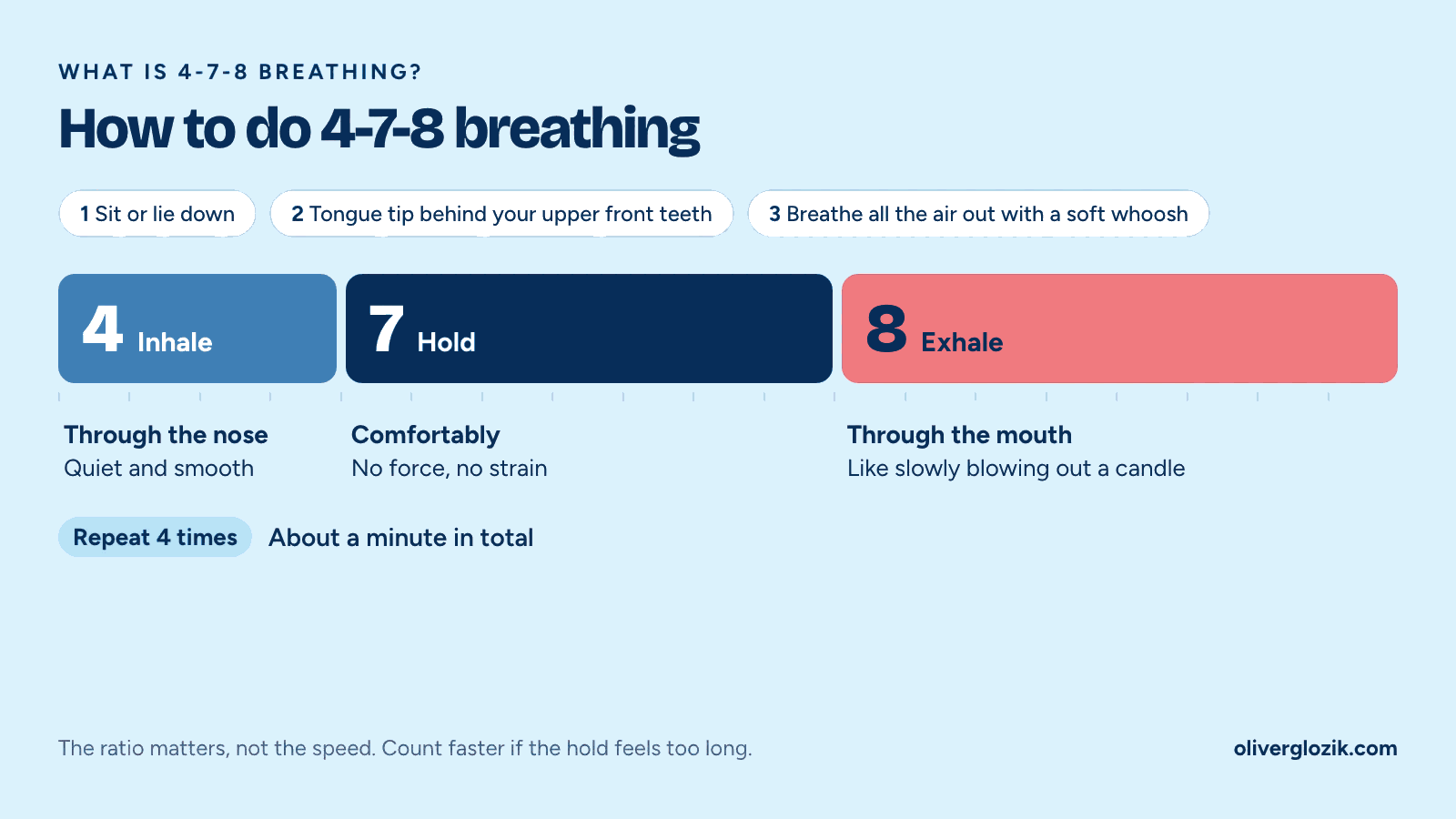
On the exhale, imagine you are slowly blowing out a candle. Not blowing it out in one go, but pressing your lips a little together and letting the air leave slowly and evenly. That picture helps people to keep the exhale long.
The counts don’t have to be exact seconds. What matters is the ratio, not the speed. If a hold of seven feels too long, count faster, but keep the 4:7:8 rhythm. How many rounds to do, and how often, I explain further down.
I find 4-7-8 is easiest when you follow a guided audio or video that tells you now inhale, now hold, now exhale. Then you don’t have to count or think at all, and you can simply follow and feel.
Where 4-7-8 breathing comes from
4-7-8 breathing comes from yogic pranayama and was made popular by Dr Andrew Weil, the Harvard-trained doctor who founded the Andrew Weil Center for Integrative Medicine at the University of Arizona. He calls it the Relaxing Breath and describes it as a portable antidote to stress (Weil).
You sometimes read that 4-7-8 comes from sama vritti. In yoga, sama vritti means “equal breathing”, where the inhale and exhale have the same count, like in box breathing. 4-7-8 does the opposite on purpose: the exhale is twice as long as the inhale. So it is closer to say it is rooted in pranayama in general, with its own modern ratio.
Why does 4-7-8 breathing work?
4-7-8 breathing works by slowing your breath right down, making the exhale twice as long as the inhale, and giving your mind a job to do. There are three things happening at once.
It slows your breathing rate. If you count in seconds, one round takes 19 seconds. That is about three breaths a minute, while an adult normally breathes 12 to 20 times a minute at rest. A review of 15 studies found that breathing slower than 10 times a minute is linked with a more relaxed nervous system, more comfort and less anxiety (Zaccaro et al., 2018).
It makes the exhale long. Breathing out is the calming half of the breath. One leading idea is that a long, slow exhale stimulates the vagus nerve, the main nerve of the rest and repair nervous system (Gerritsen & Band, 2018). That is a model, not a proven fact, but it fits what people feel: the long exhale tells your body it is safe.
It gives your mind an anchor. You have to count, hold and slow down, all at once. There is a little challenge in it, and that is exactly the point: while you are counting to seven and then to eight, your mind can’t run after the worry at the same time. The mind chatter gets quieter because it has something better to do.
“Most of the time, breathing happens unconsciously. But you always have conscious access to it. 4-7-8 is a great way to get in touch with that.”
 Oliver GlozikBreathwork facilitator, hypnotist and coach
How I use 4-7-8 breathing myself
I used 4-7-8 most when I was waiting before something important. I like to arrive a bit early for an important appointment, and those minutes of waiting are exactly when the nerves come up. A few rounds of 4-7-8 and I am back in my body and in the present moment.
I also used it a lot in the early days of hosting retreats, sharing circles and breathwork sessions, to ground myself before I held space for others. These days I can get into that grounded state without a technique, but 4-7-8 helped me learn what that state feels like. That is, for me, the real value of any breathing practice: it teaches you to feel your breath consciously, until you can find that calm on your own.
Is 4-7-8 breathing good for anxiety?
4-7-8 breathing is one of the best quick tools I know for nervousness and anxiety in the moment. Think of the minutes before an important conversation, a job interview, or even before you send an important voice note and feel that tightness inside. Four rounds of 4-7-8 can bring you back to calm and grounded.
It is less suited to moments when you need to be switched on, like right before a sports match where you have to be ready to go. 4-7-8 slows you down. For focus I’d rather use box breathing, which I compare below.
The research on 4-7-8 and anxiety is promising but small. In a trial with 90 patients after weight-loss surgery, the group that learned 4-7-8 breathing had lower anxiety afterwards than both a deep breathing group and a group with routine care (Aktaş & İlgin, 2023). 4-7-8 is a tool for the moment, not a treatment for an anxiety disorder. If anxiety is shaping your life, please also talk to a doctor or therapist.
Does 4-7-8 breathing help you sleep?
4-7-8 breathing can help you wind down before sleep, but there is no proof that it puts you to sleep in 60 seconds, as some viral videos promise. Lying in bed, four rounds with the lights off can slow you down and take your attention away from the thoughts that keep you awake.
The only randomised trial I found that measured sleep was in people with tinnitus. After six weeks of four rounds in the morning and four in the evening, their insomnia scores roughly halved, while the control group didn’t change (Kirazli et al., 2026). It was a small study of 48 people, so it is a good sign, not a final answer.
I’ll be honest about how I handle it myself. There are times in my life when I sleep easily and times when I don’t. When sleep is hard, I personally often prefer to stay awake and resolve what needs resolving inside me, instead of breathing it away. A breathing technique can calm the body, but if something is keeping you awake night after night, it is worth looking at what it is.
What the research says about 4-7-8 breathing
Research on 4-7-8 breathing shows real calming effects in small studies, but it is not proven to be better than other slow breathing techniques. Here is what the studies actually tested.
- Heart rate and blood pressure. In a study of 43 healthy young adults, three sets of 4-7-8 breathing lowered the heart rate by about 3 to 5 beats a minute and the systolic blood pressure by about 3 to 4 points. The study measured only the immediate effect and the groups were not randomised (Vierra et al., 2022).
- Anxiety. The surgery trial above found less anxiety in the 4-7-8 group than in the other two groups (Aktaş & İlgin, 2023).
- Sleep. The tinnitus trial above found better sleep scores after six weeks (Kirazli et al., 2026).
- Compared with other techniques. A study of 84 students compared 4-7-8, box breathing and breathing at six breaths a minute in one session. Six breaths a minute raised heart rate variability, a marker of a relaxed nervous system, more than either 4-7-8 or box breathing, and none of the techniques changed mood or blood pressure in that single sitting. The authors also note that 4-7-8 is popular with therapists but has little research behind it (Marchant et al., 2025).
So the honest picture is this: 4-7-8 is not a magic ratio. Its strengths are that it is simple, it is easy to remember, and the hold and long exhale give the mind something to focus on. Across all types of breathwork, the biggest review so far found a small to medium effect on stress (Fincham et al., 2023), and that is the realistic expectation for 4-7-8 too.
4-7-8 vs box breathing vs slow breathing
4-7-8 is best for calming down, box breathing for focus, and slow breathing at six a minute for longer daily practice. Everybody has their own body and their own preferences. Some people love the long hold, others find it uncomfortable. Try different types and find the one that works for you.
| Technique | How you breathe | Best for | How long |
|---|---|---|---|
| 4-7-8 breathing | In for 4, hold for 7, out for 8 | Calming down, nerves, winding down at night | 4 rounds, about a minute |
| Box breathing | In for 4, hold for 4, out for 4, hold for 4 | Focus and staying calm under pressure | A few minutes |
| Slow breathing | About 6 breaths a minute, for example in for 4, out for 6, no hold | A daily practice for a relaxed nervous system | 5 to 20 minutes |
If you want something even quicker, with no counting at all, try the physiological sigh breathing technique: two inhales through the nose and one long exhale.
If you want to see how these compare with longer forms of breathwork, like conscious connected breathing, read what breathwork is and the main types.
The biggest beginner mistake
The most common mistake with 4-7-8 is breathing out too quickly. People let the air rush out in the first two or three counts, and then they have nothing left for the count of eight. Remember the candle: slow, even, lips slightly together, so the air lasts the full eight counts.
Other mistakes I see:
- Forcing it. The breath should be smooth and gentle, never strained. The focus is on the timing, not on how much air you move.
- Holding too hard. The hold should feel comfortable. If you feel strain, count faster or shorten the numbers.
- Doing it once and giving up. If you use 4-7-8 once in your life and it works, and then you never use it again, you get a limited benefit. Practise it regularly, for example every evening, so it is there for you when you really need it.
How many rounds of 4-7-8 breathing, and how often?
Do four rounds at a time for the first month, build up to a maximum of eight after that, and practise at least twice a day. That is Dr Weil’s guidance (Arizona Center for Integrative Medicine), and it matches how I learned it.
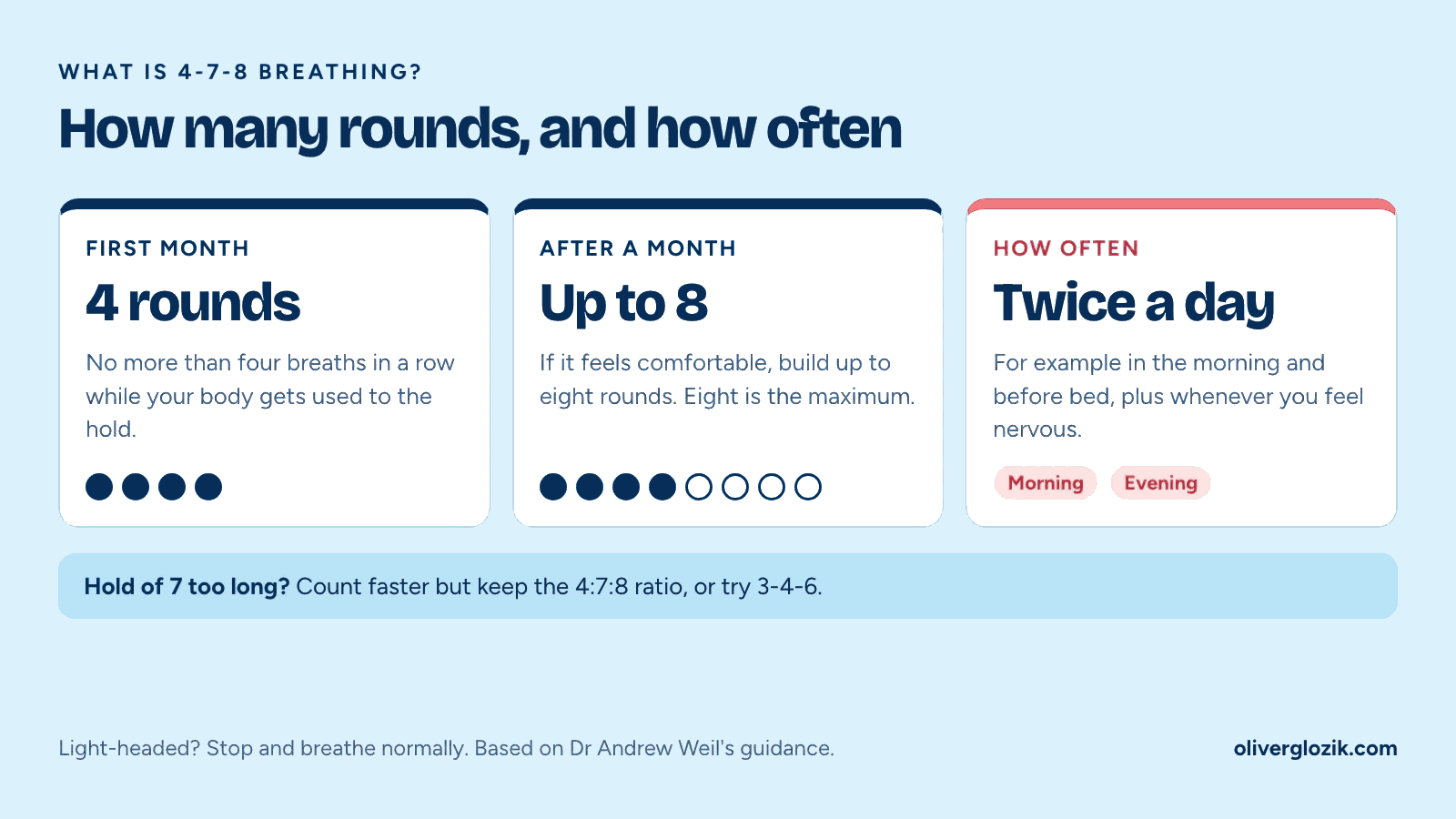
- First month: four rounds in a row, no more. The hold of seven is new for most people, and doing many holds in a row can make you light-headed while your body gets used to it.
- After a month: up to eight rounds. Only if four feels easy and comfortable. Weil calls eight the maximum, so more is not better here.
- How often: twice a day. For example once in the morning and once before bed. Then you also use it in the moments you need it, like before an important conversation.
Twice a day is what turns 4-7-8 from a trick into a skill. The more you practise when you are calm, the easier it is to find that calm when you are nervous.
Is 4-7-8 breathing safe?
4-7-8 breathing is safe for most people when you do it sitting or lying down. Feeling a little light-headed the first few times is common and passes. If it happens, stop and breathe normally.
- If the hold of seven is hard, for example with asthma or COPD, use smaller numbers like 3-4-6, or shorten the hold, and stop if you feel breathless.
- If you are pregnant or have a heart or lung condition, keep the breath gentle, skip or shorten the hold, and check with your doctor if you are unsure.
- Never do it while driving or in water, because holding your breath can make you light-headed.
Breathwork can support you, but it does not replace medical or psychological care.
Questions about 4-7-8 breathing
How many times should I do 4-7-8 breathing?
Do four rounds at a time, twice a day for the first month. After that you can build up to eight rounds at most.
What if I can’t hold my breath for seven seconds?
Count faster but keep the 4:7:8 ratio, or use smaller numbers like 3-4-6. The ratio matters more than the seconds.
Should I breathe through my nose or my mouth?
In through the nose, out through the mouth with a soft whoosh, with the tip of your tongue behind your upper front teeth.
Does 4-7-8 breathing work straight away?
Many people feel calmer after the first four rounds. It becomes more reliable when you practise it regularly.
Is 4-7-8 breathing the same as box breathing?
No. Box breathing uses four equal counts of four and is better for focus. 4-7-8 has a long hold and an even longer exhale, which makes it better for calming down.
Is 4-7-8 breathing good before an important conversation?
Yes, it is one of my favourite uses for it. A few rounds before a difficult talk, a meeting or an important message help you show up calm and grounded.
References
- Weil, A. Three breathing exercises and techniques. DrWeil.com. https://www.drweil.com/health-wellness/body-mind-spirit/stress-anxiety/three-breathing-exercises-and-techniques/
- Andrew Weil Center for Integrative Medicine, University of Arizona. Breathing: three exercises (patient handout). https://awcim.arizona.edu/file?id=138394
- Zaccaro, A., Piarulli, A., Laurino, M. et al. (2018). How breath-control can change your life: a systematic review on psycho-physiological correlates of slow breathing. Frontiers in Human Neuroscience, 12, 353. https://doi.org/10.3389/fnhum.2018.00353
- Gerritsen, R. J. S. & Band, G. P. H. (2018). Breath of life: the respiratory vagal stimulation model of contemplative activity. Frontiers in Human Neuroscience, 12, 397. https://doi.org/10.3389/fnhum.2018.00397
- Aktaş, G. K. & İlgin, V. E. (2023). The effect of deep breathing exercise and 4-7-8 breathing techniques applied to patients after bariatric surgery on anxiety and quality of life. Obesity Surgery, 33, 920 to 929. https://doi.org/10.1007/s11695-022-06405-1
- Kirazli, G., Baran, S., Uysal, G. S. et al. (2026). The effect of 4-7-8 breathing exercise technique on tinnitus handicap, psychological factors, and sleep quality in tinnitus patients: a randomized controlled study. Brain and Behavior, 16(2), e70854. https://doi.org/10.1002/brb3.70854
- Vierra, J., Boonla, O. & Prasertsri, P. (2022). Effects of sleep deprivation and 4-7-8 breathing control on heart rate variability, blood pressure, blood glucose, and endothelial function in healthy young adults. Physiological Reports, 10(13), e15389. https://doi.org/10.14814/phy2.15389
- Marchant, J., Khazan, I., Cressman, M. & Steffen, P. (2025). Comparing the effects of square, 4-7-8, and 6 breaths-per-minute breathing conditions on heart rate variability, CO2 levels, and mood. Applied Psychophysiology and Biofeedback, 50(2), 261 to 276. https://doi.org/10.1007/s10484-025-09688-z
- Fincham, G. W., Strauss, C., Montero-Marin, J. & Cavanagh, K. (2023). Effect of breathwork on stress and mental health: a meta-analysis of randomised-controlled trials. Scientific Reports, 13, 432. https://doi.org/10.1038/s41598-022-27247-y
Want to try it for yourself?
See how my breathwork sessions work, or book a free call and ask me anything first.