What Is Box Breathing? How to Do It and When It Helps
By Oliver Glozik ·
What is box breathing? Box breathing is a slow breathing pattern with four equal parts: you inhale for a count of four, hold for four, exhale for four and hold for four, then start again. Picture going around the four sides of a square. It is also called square breathing, 4x4 breathing or, in yoga, Sama Vritti. A former Navy SEAL made it famous, but you don’t need a military background to use it. I use it day to day, in the breaks between my concentrated work sessions. In this post I explain how to do it, how I use it, and what it can and can’t do according to the research.
Box breathing at a glance
- The pattern: inhale for 4, hold for 4, exhale for 4, hold for 4.
- How long: start with 3 to 5 minutes. Unlike 4-7-8 breathing, there is no strict limit on rounds.
- What people use it for: regrounding and refocusing, calming down in a moment of anxiety, settling nerves before a big moment.
- The research: small trials show short-term benefits for stress, anxiety and mood, but the results are not uniform.
- My tip: a guided video makes it easy to follow, and classical music helps you get out of your head.
How to do box breathing, step by step
Sit or lie down, breathe all your air out, then go around the box: in for 4, hold for 4, out for 4, hold for 4.
- Get comfortable. Sit with your back supported or lie down. Never do this while driving or in water.
- Empty your lungs. Breathe out slowly until the air is gone.
- Inhale for 4. Breathe in through your nose, quietly and smoothly.
- Hold for 4. Keep the air in, without tensing your throat or shoulders.
- Exhale for 4. Let the air out slowly and evenly. Mark Divine teaches this through the nose (Divine, 2016), and other guides use the mouth, so do what feels easy.
- Hold for 4. Stay empty and relaxed until the next inhale.
- Repeat for 3 to 5 minutes to begin with.
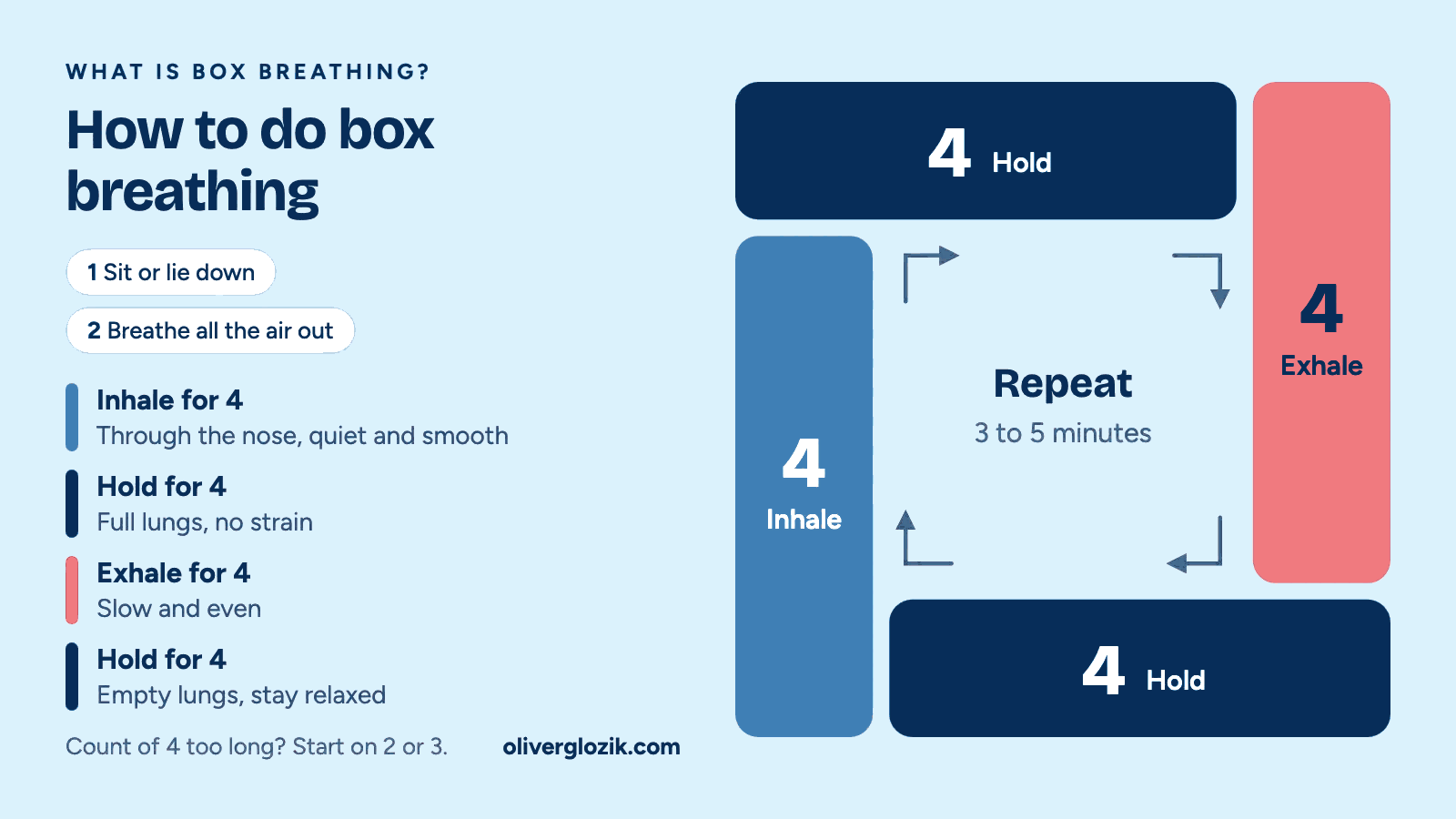
If a count of four is too long, start on two or three. In my breathwork certification, a count of four was described as comfortably challenging for many students, and shorter counts as perfectly fine. You should feel at ease the whole way around.
How I use box breathing myself
I work in concentrated blocks of 45 minutes, and in the break between them I do box breathing. It helps me reground, refocus and reconcentrate, and then I start the next 45 minutes. That is my day-to-day use of it.
I do it with classical music. One challenge at the start is simply how to follow the breath: when do I hold, when do I exhale? A guided video makes that very easy, because you can see each step. Guides where a sound tells you when to inhale, hold and exhale work too.
But I noticed that if you do that too much, you are still a bit more in your head. That is why I prefer melodic, instrumental classical pieces with a four-beat. The music itself is soothing, and I can follow it on my own intuitive rhythm. I might miss a beat here or there, and I think that is great, because then I am not so much in my head and I can let go more. It takes me into a calmer, more concentrated space.
I don’t find the holds very challenging. They are limited to four, after the inhale and after the exhale, which I find a very reasonable time. There are no extended holds or exhales like in 4-7-8, so in some ways box breathing might be the easier one to practise.
“One or two times can help, but the more I use this tool, the more it’s like a muscle.”
 Oliver GlozikBreathwork facilitator, hypnotist and coach
Is box breathing good for anxiety?
Box breathing can help in a moment of anxiety, and short-term relief is also where the research is strongest. I remember a person at a retreat who had a lot of anxiety. We did box breathing together, the person felt better afterwards, and it helped calm the situation we were in.
When people are in very anxious states, a clear instruction helps a lot. You can talk about this and that, but it is something else to say: okay, now we are going to follow this video together for the next 10 minutes.
Box breathing is a tool for the moment, not a treatment for an anxiety disorder. If anxiety is shaping your life, please also talk to a doctor or therapist.
Is box breathing good for focus?
Box breathing helps me concentrate, but the research doesn’t prove that it sharpens focus. I found no study showing it. In one lab study, 30 people did a demanding task under time pressure and noise using either tactical breathing or a long exhale. Tactical breathing lowered their physical arousal more, but they performed better on the task with the long exhale, and they didn’t feel any different between the two (Röttger et al., 2021). So take this part as my personal experience, and test it for yourself.
Does box breathing help athletes?
Some athletes use box breathing to handle pressure, but I found no good evidence yet that it improves performance. The best-known example is the NFL quarterback Aaron Rodgers, who has said he does it before games and before two-minute drives. When he guest-hosted Jeopardy! in 2021, he also used it to settle his nerves (Hodkiewicz, 2021). Even he said “Not sure it worked every single time”, though he did feel better afterwards (Mitas, 2021).
In a student project with 32 participants and no control group, anxiety scores fell after adding box breathing to a basketball free-throw routine (Melzar, 2025). That is a promising sign for nerves, not proof of better results.
What the research says about box breathing
Box breathing shows modest short-term benefits, mostly in small studies.
- The overall picture. A 2026 systematic review of randomised trials found short-term benefits for perceived stress, anxiety and mood, but not uniformly, and inconsistent effects on wider measures of the nervous system. The studies are few and varied, with little long-term follow-up (Dujawara et al., 2026).
- Five minutes a day for a month. In a remote trial, the box breathing group’s anxiety score fell by about 3.8 points after each session on a scale from 20 to 80, nearly the same as a mindfulness group. Cyclic sighing, not box breathing, was the exercise that clearly beat mindfulness for mood. Only around 20 people did box breathing (Balban et al., 2023).
- Compared with other techniques. In one session with 84 students, breathing at six breaths a minute raised heart rate variability, a marker of a relaxed nervous system, more than box breathing or 4-7-8. No technique meaningfully changed mood or blood pressure in that sitting (Marchant et al., 2025).
- After hard exercise. In a trial with 62 cadets, box breathing and cyclic sighing after a maximal fitness test both helped a marker of the rest and repair nervous system recover better than normal breathing (Jones et al., 2026).
Part of why it may work is simply the pace. Counted in seconds, one round takes 16 seconds, which is under four breaths a minute, and a review of 15 studies linked breathing slower than 10 times a minute with more relaxation and less anxiety (Zaccaro et al., 2018). Across all types of breathwork, the biggest review so far found a small to medium effect on stress (Fincham et al., 2023).
So don’t expect magic. You will read long lists of benefits elsewhere, like lower blood pressure, better digestion and a stronger immune system. I didn’t find box breathing studies that show those, so I am not claiming them.
Where box breathing comes from
The name was made famous by Mark Divine, a former US Navy SEAL. Divine says he developed his version to carry on his breath training after leaving the SEALs (Divine, 2016). Researchers note its use in the military, where it is also called tactical breathing (Balban et al., 2023). In my breathwork training it was taught as Sama Vritti, a yogic breath whose name means “equal flow”.
Box breathing vs 4-7-8 vs slow breathing
For me, box breathing is for concentration and 4-7-8 is for calming down. Everybody has their own body and preferences. Try both, and keep the one you connect with most as your fallback. I explain the other one in what the 4-7-8 breathing technique is.
| Technique | How you breathe | What it is often used for | How long |
|---|---|---|---|
| Box breathing | In for 4, hold for 4, out for 4, hold for 4 | Regrounding and concentration | From 3 to 5 minutes, and longer once it is easy |
| 4-7-8 breathing | In for 4, hold for 7, out for 8 | Calming down, nerves | 4 rounds, up to 8 after a month |
| Slow breathing | About 6 breaths a minute, for example in for 4, out for 6, no hold | A daily practice for a relaxed nervous system | 5 to 20 minutes |
One benefit of box breathing is that you can do more of it in one go. For longer forms like conscious connected breathing, read what breathwork is and the main types.
How long should you do box breathing, and how often?
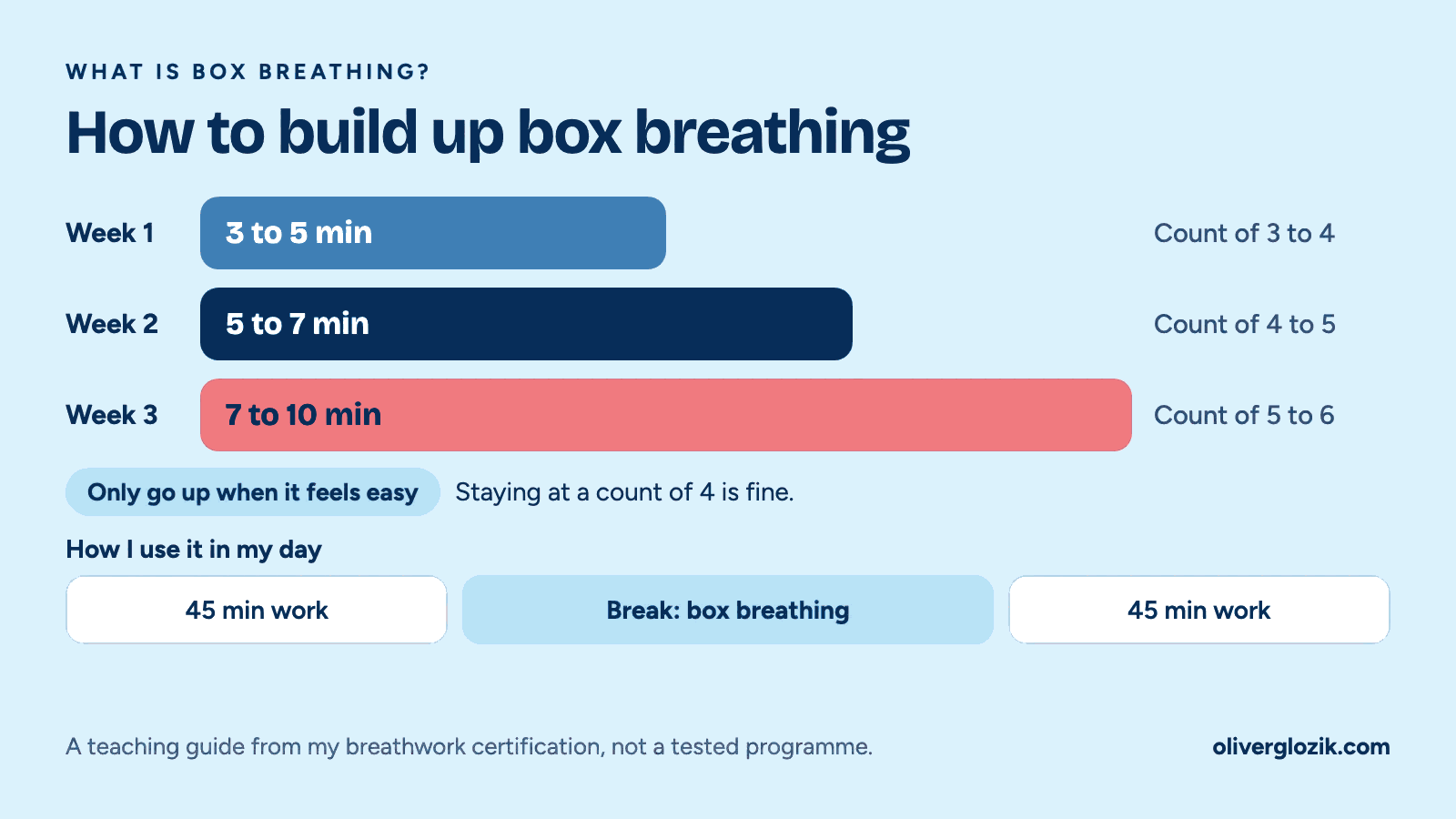
Start with 3 to 5 minutes and build up slowly. A few minutes regularly is better than pushing for long sessions. Guidance varies: the Cleveland Clinic suggests three or four rounds, once or twice a day (Cleveland Clinic, 2021), Mark Divine suggests at least five minutes (Divine, 2016), and the month-long trial above used five minutes a day.
Why do it regularly? Think of yourself as a pressure cooker. Tension accumulates through the days. If you take conscious time, say once a day, for some concentrated breathing, you let go of that pressure on a regular basis. If you only do it when the pressure is exploding it still works, but I recommend making it a regular thing.
Three things get in the way:
- Pushing the count. Longer is not better. Only go up when your current count feels easy.
- Tensing up in the holds. Holding your breath can itself set off a stress response. Keep letting go of tension, or shorten the count.
- Worrying about the count. Missing a beat doesn’t matter. Pick up the rhythm again.
Is box breathing safe?
Most people can try box breathing sitting or lying down, as long as it stays comfortable. I didn’t find research on who should avoid it specifically, so this is cautious general advice for breath holds.
- If you feel dizzy, stop, lie down and breathe normally. Don’t stand up. Light-headedness can happen to beginners and usually fades with practice.
- If you faint, you have gone too far. Check with your doctor before you continue.
- If holding your breath makes you more anxious, shorten the holds or leave them out, and just breathe slowly.
- If you are pregnant or have a heart or lung condition, keep the breath gentle, skip or shorten the holds, and check with your doctor if you are unsure.
- Never do it while driving or in water, because holding your breath can make you light-headed.
Breathwork can support you, but it does not replace medical or psychological care.
Questions about box breathing
Why is it called box breathing?
Because it has four equal parts, like the four sides of a box: inhale, hold, exhale, hold.
Is box breathing the same as Sama Vritti?
In my training they were taught as the same practice. Sama Vritti means “equal flow”.
Do Navy SEALs really use box breathing?
The technique was made famous by former SEAL Mark Divine, and researchers note its use in the military. I didn’t find good evidence on how widely the SEALs themselves train it.
How is box breathing different from 4-7-8 breathing?
Box breathing has four equal counts and a hold on empty lungs. 4-7-8 breathing has a longer hold, an even longer exhale, and a limit on rounds.
References
- Divine, M. (2016, 4 May). The breathing technique a Navy SEAL uses to stay calm and focused. TIME. https://www.time.com/4316151/breathing-technique-navy-seal-calm-focused
- Röttger, S., Theobald, D. A., Abendroth, J. & Jacobsen, T. (2021). The effectiveness of combat tactical breathing as compared with prolonged exhalation. Applied Psychophysiology and Biofeedback, 46(1), 19 to 28. https://doi.org/10.1007/s10484-020-09485-w
- Hodkiewicz, W. (2021, 5 April). Aaron Rodgers wanted to do Alex Trebek justice as “Jeopardy!” guest host. Packers.com. https://www.packers.com/news/aaron-rodgers-wanted-to-do-alex-trebek-justice-as-jeopardy-guest-host
- Mitas, M. (2021, 5 April). “Jeopardy!”: Aaron Rodgers revealed the “code words” he kept at the lectern while guest hosting. Cheat Sheet. https://www.cheatsheet.com/news/jeopardy-aaron-rodgers-revealed-code-words-he-kept-lectern-while-guest-hosting.html
- Melzar, Z. (2025). The impact of box-breathing in the pre-shot routine on anxiety reduction and improved free-throw performance. Senior project, Allegheny College. https://hdl.handle.net/10456/59252
- Dujawara, A., Ali, K. & Kumari, S. (2026). Systematic review of randomised controlled trials evaluating box breathing for stress, autonomic, and clinical outcomes. Applied Psychophysiology and Biofeedback. https://doi.org/10.1007/s10484-026-09812-7
- Balban, M. Y., Neri, E., Kogon, M. M. et al. (2023). Brief structured respiration practices enhance mood and reduce physiological arousal. Cell Reports Medicine, 4(1), 100895. https://doi.org/10.1016/j.xcrm.2022.100895
- Marchant, J., Khazan, I., Cressman, M. & Steffen, P. (2025). Comparing the effects of square, 4-7-8, and 6 breaths-per-minute breathing conditions on heart rate variability, CO2 levels, and mood. Applied Psychophysiology and Biofeedback, 50(2), 261 to 276. https://doi.org/10.1007/s10484-025-09688-z
- Jones, M. E., Smith, G., Acevedo, A. & Melton, B. (2026). Effectiveness of structured breathwork interventions on heart rate variability and heart rate recovery following maximal exertion in tactical athletes. Medicine & Science in Sports & Exercise, 58(7), 1524 to 1533. https://doi.org/10.1249/MSS.0000000000003972
- Zaccaro, A., Piarulli, A., Laurino, M. et al. (2018). How breath-control can change your life: a systematic review on psycho-physiological correlates of slow breathing. Frontiers in Human Neuroscience, 12, 353. https://doi.org/10.3389/fnhum.2018.00353
- Fincham, G. W., Strauss, C., Montero-Marin, J. & Cavanagh, K. (2023). Effect of breathwork on stress and mental health: a meta-analysis of randomised-controlled trials. Scientific Reports, 13, 432. https://doi.org/10.1038/s41598-022-27247-y
- Young, M. (2021). Box breathing benefits and techniques. Cleveland Clinic Health Essentials. https://health.clevelandclinic.org/box-breathing-benefits
Want to try it for yourself?
See how my breathwork sessions work, or book a free call and ask me anything first.