The Physiological Sigh Breathing Technique: How to Do It and What the Stanford Study Found
By Oliver Glozik ·
What is the physiological sigh breathing technique? The physiological sigh is a double inhale through the nose followed by one long, slow exhale through the mouth.
You breathe in, then take a second short sip of air on top to fill your lungs completely, then let it all go. Your body already does this by itself several times an hour.
Done on purpose, one sigh takes about 10 seconds, and five minutes of repeated sighs is called cyclic sighing, which a 2023 Stanford study found improved mood more than mindfulness meditation.
I use it in three different moments: when I feel overwhelmed, when I already feel at peace and want to go deeper, and with clients at the start of a hypnosis session. In this post I explain how to do it, how I use it, and what the research does and doesn’t show.
The physiological sigh at a glance
- The pattern: a full inhale through the nose, a short second inhale on top, then a long exhale through the mouth.
- How long: one to three sighs as a quick reset, or five minutes a day as cyclic sighing.
- What people use it for: letting go of built-up tension, calming down in a stressful moment, settling into a calm state.
- The research: one month-long Stanford trial found it lifted mood more than mindfulness, but it calmed anxiety about the same. The studies are still small.
- Why I like it: you don’t need a count, a rhythm or a video. You can do it anywhere, right away.
How to do the physiological sigh, step by step
Breathe in through your nose until your lungs feel full, sip in a little more, then breathe out slowly through your mouth until you’re empty.
- Sit or lie down if you can. Never practise it for minutes at a time while driving or in water.
- Inhale through your nose. A slow, deep breath that fills your lungs.
- Take a second inhale on top. When you feel full, sip in a little more air through your nose. It will be shorter and smaller than the first, and that’s normal.
- Exhale slowly through your mouth. Let all the air out, longer than the two inhales together. This long exhale is the part that settles you.
- Repeat. One to three sighs for a quick reset. For cyclic sighing, keep going for five minutes, then return to normal breathing.
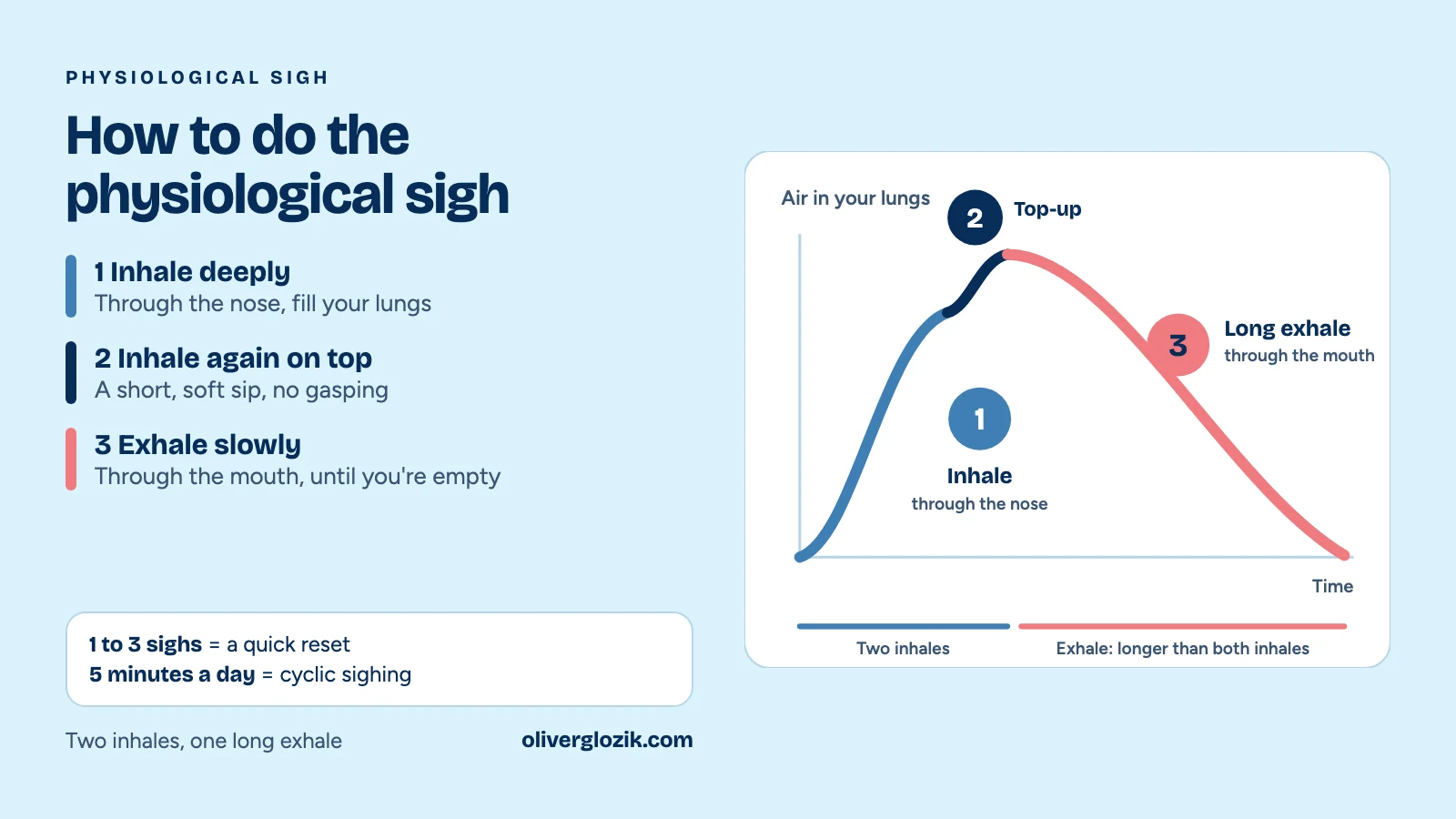
These are close to the instructions used in the Stanford trial, which also allowed breathing out through the nose if that feels better (Balban et al., 2023).
Keep it soft. The second inhale is a top-up, not a gasp. If you’ve done yoga, it may feel familiar: in my breathwork certification we learned Viloma, the “ladder breath”, where you fill your lungs in stages. The teaching there was the same one I’d give here: keep the breath gentle and relaxed, and avoid gasping for air.
One sigh or cyclic sighing?
A single physiological sigh is a quick reset. Cyclic sighing is the same breath repeated for five minutes as a daily practice. The parent name in the research is cyclic sighing, and that’s the version the Stanford study tested.
| One sigh | Cyclic sighing | |
|---|---|---|
| What you do | One to three double inhales with long exhales | Double inhales with long exhales, again and again |
| How long | 10 to 30 seconds | 5 minutes |
| When | In the moment: overwhelm, tension, a stressful situation, or before hypnosis | Once a day, as a practice |
| Evidence | Based on how the body sighs on its own; not tested as a single breath | Tested in a month-long trial |
Where the physiological sigh comes from
Your body invented it. Everyone sighs spontaneously, every few minutes, without noticing. In everyday breathing, a sigh is an extra-deep breath, often taken as a breath on top of a breath. Scientists call it a physiological sigh to tell it apart from the sigh you make when you’re sad or fed up.
Researchers think it has a very practical job. Your lungs are made of millions of tiny air sacs, and over time some of them partly collapse. A sigh pops them open again (Severs et al., 2022). In mice, a small group of nerve cells in the brainstem triggers sighing, and when those cells are removed, the animals stop sighing (Li et al., 2016). People sigh more when they’re stressed, and in studies, a spontaneous sigh often marks a moment of relief, like the breathing system pressing reset (Vlemincx et al., 2010).
It isn’t only humans. Other mammals sigh too, from mice to dogs. I notice it with my own dog: when he settles down to sleep, he lets out a very similar sigh. It’s his way of saying: my day is done, now it’s time to rest. Researchers link sighing to exactly these shifts, from one state of the body to another (Balban et al., 2023).
The name “physiological sigh” as a breathing technique was made popular by Andrew Huberman, a neuroscientist at Stanford, through his podcast. He also co-led the 2023 study.
Why the physiological sigh works
The double inhale fills your lungs fully, and the long exhale tells your body it’s safe to slow down. This is where the vagus nerve comes in. It’s the main nerve of your rest-and-digest system, and it helps set your heart rate. Every time you breathe in, your heart speeds up a little, and every time you breathe out, the vagus nerve slows it down again. A long, slow exhale gives that slowing more time, which is one reason slow breathing with long exhales is linked to relaxation (Zaccaro et al., 2018). The Stanford authors describe cyclic sighing as an exhale-focused practice.
Over the month of their trial, people who did cyclic sighing ended up breathing more slowly even at rest, and the more their breathing slowed, the better their mood (Balban et al., 2023). One honest note: heart rate variability, a common way to measure this vagus nerve effect, didn’t change over that month, so how much a daily practice changes your nervous system in the long run isn’t clear yet.
“You don’t need to think about anything. You don’t need to think about a rhythm. That’s the great part about the sigh.”
 Oliver GlozikBreathwork facilitator, hypnotist and coach
How I use the physiological sigh myself
I use the sigh in three distinct situations.
The first is when I feel overwhelmed. It’s that moment when I go: oof. That exhale gives me a level of relaxation straight away. Sometimes so much pressure and tension builds up that we don’t even notice it. Too much coffee, a phone full of messages, news from all around the world. We start tensing up, and even our breathing becomes shallow. When I notice that, I tell myself: take a moment. And one sigh releases a lot of it.
The second is the opposite: when I already feel content. When I feel calm, a deeper level of inner peace, the sigh takes me further into it. The depth of the breath somehow matches how deeply I’m experiencing life in that moment. I like to look into the distance while I do it, and it gives me a deep sense of satisfaction, whatever is in my bank account, whatever difficulties life is giving me right now. There’s still me, my own spirit, underneath all of that. The sigh is what reminds me.
The third is with clients, at the start of a hypnosis session. When I begin hypnosis with someone, I have them look upwards, and we take three sighs together. It helps them relax before we go any further.
Is the physiological sigh good for anxiety?
It can help in the moment, and it’s the easiest calming breath to reach for. In the Stanford study it lowered anxiety about as much as mindfulness, not more (see the research below).
I encourage people to start using it more in daily life, including when they feel anxious. Box breathing is great and 4-7-8 is great, but many people still need to open YouTube and follow a video to do them. That’s not far away, but it’s so much easier to just take a sigh. It’s always there.
The sigh is a tool for the moment, not a treatment for an anxiety disorder. If anxiety is shaping your life, please also talk to a doctor or therapist. If deep breathing ever makes your anxiety worse, stop and breathe normally.
What the research says about the physiological sigh
The best evidence is one small but well-known Stanford trial, and it’s narrower than the headlines.
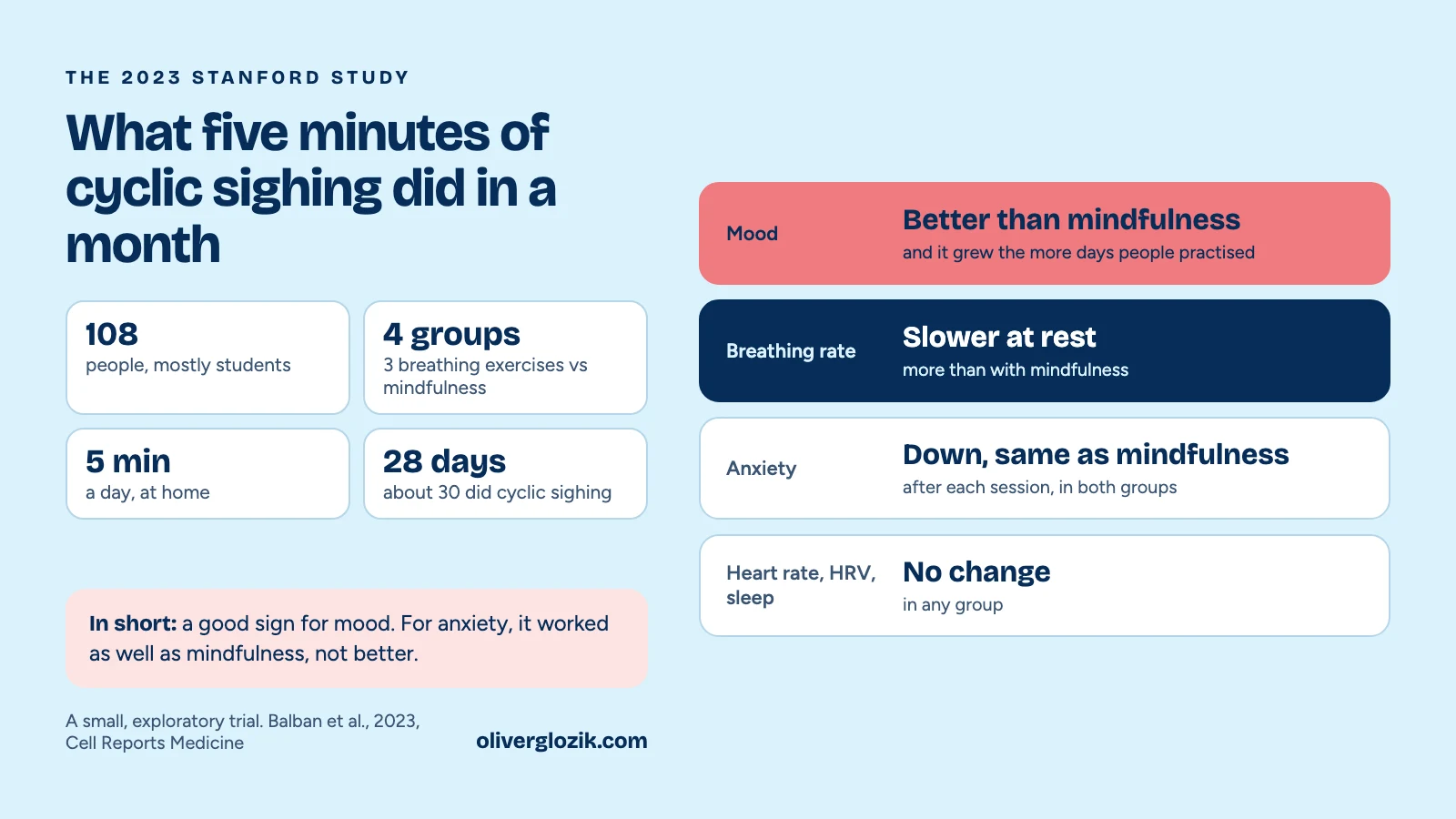
- The 2023 Stanford study. Researchers at Stanford University School of Medicine, led by David Spiegel and Andrew Huberman, asked 108 people, mostly students, to do five minutes a day of cyclic sighing, box breathing, fast breathing with holds, or mindfulness meditation for a month. About 30 people were in the cyclic sighing group (Balban et al., 2023).
- Mood: cyclic sighing raised positive mood after each session significantly more than mindfulness, and the effect grew the more days people practised. The other two breathing exercises also beat mindfulness on mood, but not by enough to be sure.
- Anxiety: it fell about equally in the sighing and mindfulness groups.
- Breathing rate: the cyclic sighing group’s resting breathing rate fell more than the mindfulness group’s.
- No change in heart rate variability, resting heart rate or sleep in any group.
- The limits: the authors call it exploratory. The groups were small, people practised at home, the trial lasted only four weeks, and it was registered after it had started. They plan a larger trial. Huberman later became an adviser to WHOOP, whose wristbands measured the data, though the company wasn’t involved in the design or analysis.
- For pain in a waiting room. In a small pilot trial, four minutes of cyclic sighing in an orthopaedic clinic’s waiting room lowered how intense and unpleasant people’s pain felt, compared with a matched control. It didn’t change their anxiety (Hanley et al., 2025).
- A sigh on command isn’t always the same. In a lab study from 2010, a spontaneous sigh during recovery from mental stress went with relief, but a sigh people were told to take did not seem to help them recover (Vlemincx et al., 2010). That was a single deep breath, not the double inhale, but it’s a fair reminder that one deliberate sigh isn’t proven to work like the body’s own.
- After hard exercise. In a trial with 62 cadets, cyclic sighing and box breathing after a maximal fitness test both helped a marker of the rest-and-repair nervous system recover better than normal breathing (Jones et al., 2026).
Across all types of breathwork, the biggest review so far found a small to medium effect on stress (Fincham et al., 2023). I found no study that tests a single sigh in a real stressful moment. That use comes from how the body sighs on its own and from experience, mine included, so treat it that way.
Physiological sigh vs box breathing vs 4-7-8
Box breathing helps me concentrate, 4-7-8 helps me calm down, and the sigh is the one I can do anywhere without thinking. Try all three, and keep the one you connect with most as your fallback.
| Technique | How you breathe | Often used for | How long |
|---|---|---|---|
| Physiological sigh | Two inhales through the nose, one long exhale through the mouth | A quick reset, letting go of tension, mood | One sigh, or 5 minutes a day |
| Box breathing | In for 4, hold for 4, out for 4, hold for 4 | Regrounding and concentration | 3 to 5 minutes and up |
| 4-7-8 breathing | In for 4, hold for 7, out for 8 | Calming down, nerves, sleep | 4 rounds |
The sigh has no holds and no counting, which is why it’s so easy to reach for. For longer forms like conscious connected breathing, read what breathwork is and the main types.
Benefits of the physiological sigh
So far the evidence supports a better mood, less anxiety after a session and a slower resting breathing rate, plus early signs for pain and recovery after exercise. You’ll read longer lists elsewhere, like lower blood pressure or better sleep. The Stanford trial found no change in sleep or heart rate, so I’m not claiming those.
Common mistakes
- Gasping the second inhale. It should be a small, quiet top-up, not a big effort.
- Rushing the exhale. The long, slow breath out is where the calm comes from. Make it longer than the inhales.
- Doing too many in a row. A few sighs are a reset. Lots of big breaths quickly can leave you dizzy or tingly. Keep the pace slow, even in a five-minute session.
- Only using it in a crisis. It works then, but practising regularly makes it easier to reach for when you need it.
Is the physiological sigh safe?
For most people a few gentle sighs are safe. It has no breath holds, which makes it one of the gentlest techniques. I didn’t find safety research specific to it, so this is cautious general advice.
- If you feel dizzy or tingly, stop and breathe normally. You’re probably breathing too fast or too hard.
- If you are pregnant or have a heart or lung condition, glaucoma or a history of seizures, check with your doctor before doing five-minute sessions. People with these conditions were left out of the Stanford trial, so it wasn’t tested on them.
- Don’t do long sessions while driving or in water.
Breathwork can support you, but it does not replace medical or psychological care.
Questions about the physiological sigh
What is the physiological sigh breathing technique?
A double inhale through the nose followed by a long exhale through the mouth. It copies the sigh your body does on its own, and doing it for five minutes is called cyclic sighing.
Is the physiological sigh the same as cyclic sighing?
Almost. The physiological sigh is the single breath. Cyclic sighing is that breath repeated for five minutes, which is what the Stanford study tested.
Why two inhales?
The second inhale fills your lungs fully, including air sacs that have partly collapsed. That gives you a big, slow exhale to let go with.
What did Andrew Huberman’s study find?
Five minutes a day of cyclic sighing lifted mood more than mindfulness meditation, but lowered anxiety about the same. It was a small, month-long study, so more research is needed.
How many physiological sighs should I do?
One to three as a quick reset, or five minutes a day as a practice.
References
- Balban, M. Y., Neri, E., Kogon, M. M., Weed, L., Nouriani, B., Jo, B., Holl, G., Zeitzer, J. M., Spiegel, D. & Huberman, A. D. (2023). Brief structured respiration practices enhance mood and reduce physiological arousal. Cell Reports Medicine, 4(1), 100895. https://doi.org/10.1016/j.xcrm.2022.100895
- Severs, L. J., Vlemincx, E. & Ramirez, J. M. (2022). The psychophysiology of the sigh: I: The sigh from the physiological perspective. Biological Psychology. https://pubmed.ncbi.nlm.nih.gov/35288214/
- Li, P., Janczewski, W. A., Yackle, K., Kam, K., Pagliardini, S., Krasnow, M. A. & Feldman, J. L. (2016). The peptidergic control circuit for sighing. Nature, 530, 293 to 297. https://doi.org/10.1038/nature16964
- Vlemincx, E., Taelman, J., Van Diest, I. & Van den Bergh, O. (2010). Take a deep breath: the relief effect of spontaneous and instructed sighs. Physiology & Behavior, 101(1), 67 to 73. https://research.vu.nl/en/publications/take-a-deep-breath-the-relief-effect-of-spontaneous-and-instructe/
- Hanley, A. W., Davis, A., Worts, P. & Pratscher, S. (2025). Cyclic sighing in the clinic waiting room may decrease pain: results from a pilot randomized controlled trial. Journal of Behavioral Medicine, 48(2), 385 to 393. https://doi.org/10.1007/s10865-024-00548-5
- Jones, M. E., Smith, G., Acevedo, A. & Melton, B. (2026). Effectiveness of structured breathwork interventions on heart rate variability and heart rate recovery following maximal exertion in tactical athletes. Medicine & Science in Sports & Exercise, 58(7), 1524 to 1533. https://doi.org/10.1249/MSS.0000000000003972
- Zaccaro, A., Piarulli, A., Laurino, M. et al. (2018). How breath-control can change your life: a systematic review on psycho-physiological correlates of slow breathing. Frontiers in Human Neuroscience, 12, 353. https://doi.org/10.3389/fnhum.2018.00353
- Fincham, G. W., Strauss, C., Montero-Marin, J. & Cavanagh, K. (2023). Effect of breathwork on stress and mental health: a meta-analysis of randomised-controlled trials. Scientific Reports, 13, 432. https://doi.org/10.1038/s41598-022-27247-y
Want to try it for yourself?
See how my breathwork sessions work, or book a free call and ask me anything first.