Hypnosis vs Meditation: One Is an Intervention, the Other a Habit
By Oliver Glozik ·
Hypnosis is a guided session aimed at a specific problem. Meditation is a practice you repeat over time to train your awareness. I think of hypnosis as an intervention and meditation as a habit. Both relax the body and focus the mind, which is why people mix them up. When researchers compare the two directly, neither clearly wins. In the biggest trial I could find, with 328 veterans in chronic pain, the hypnosis and mindfulness groups never differed significantly. So I choose by the job. For one specific pattern you want to change, I’d use hypnosis. For a long-term practice of calm and self-observation, I’d use meditation.
Key points: hypnosis vs meditation
- Hypnosis has a target. You come with a goal, such as less anxiety or no more overworking, and the session works on it.
- Meditation has no finish line. You train the distance between what happens to you and how you react.
- Hypnosis is guided and uses an induction. You follow a voice into the state. Most meditation asks you to get there yourself.
- The research is thin. The authors of a 2022 review call the direct comparisons “currently only preliminary”.
- Theta brain waves don’t separate them. Theta has been linked to hypnosis, and it also rises in mindfulness meditation.
- If closing your eyes makes your thoughts louder, you haven’t failed. Guided sessions or breathwork are easier places to start.
Hypnosis vs meditation at a glance
| Hypnosis | Meditation | |
|---|---|---|
| Purpose | Change a specific pattern or response | Train awareness and calm over time |
| How it runs | A few targeted sessions, plus a recording | A regular practice with no end date |
| Who leads | A hypnotist, or yourself in self-hypnosis | Usually you, sometimes a teacher or an app |
| Getting into the state | An induction guides you in | You build the skill through practice |
| Suggestion | The centre of the method | Not the aim of the practice |
| What you do with thoughts | Follow the voice and let them fade | Notice them and let them pass |
| Best evidence | Pain and medical procedures | Anxiety, depression and pain |
What hypnosis and meditation have in common
Both combine a relaxed body with focused attention, and both have been studied for anxiety, depression, stress and chronic pain.
A 2022 review by two University of Trento researchers lists the overlap (Penazzi & De Pisapia, 2022). Both tend to calm the stress response, although not in every study. Brain scans of each practice show partly overlapping changes in frontal, salience and default-mode networks. Older studies of Transcendental Meditation and hypnosis often found similar heart rates and skin measures.
“Meditation” also covers many practices. A person repeating a mantra, a person watching their thoughts and a person following an app are doing quite different things. Any comparison with hypnosis is a simplification, and I’d keep that in mind when reading the rest of this article.
The main difference between hypnosis and meditation
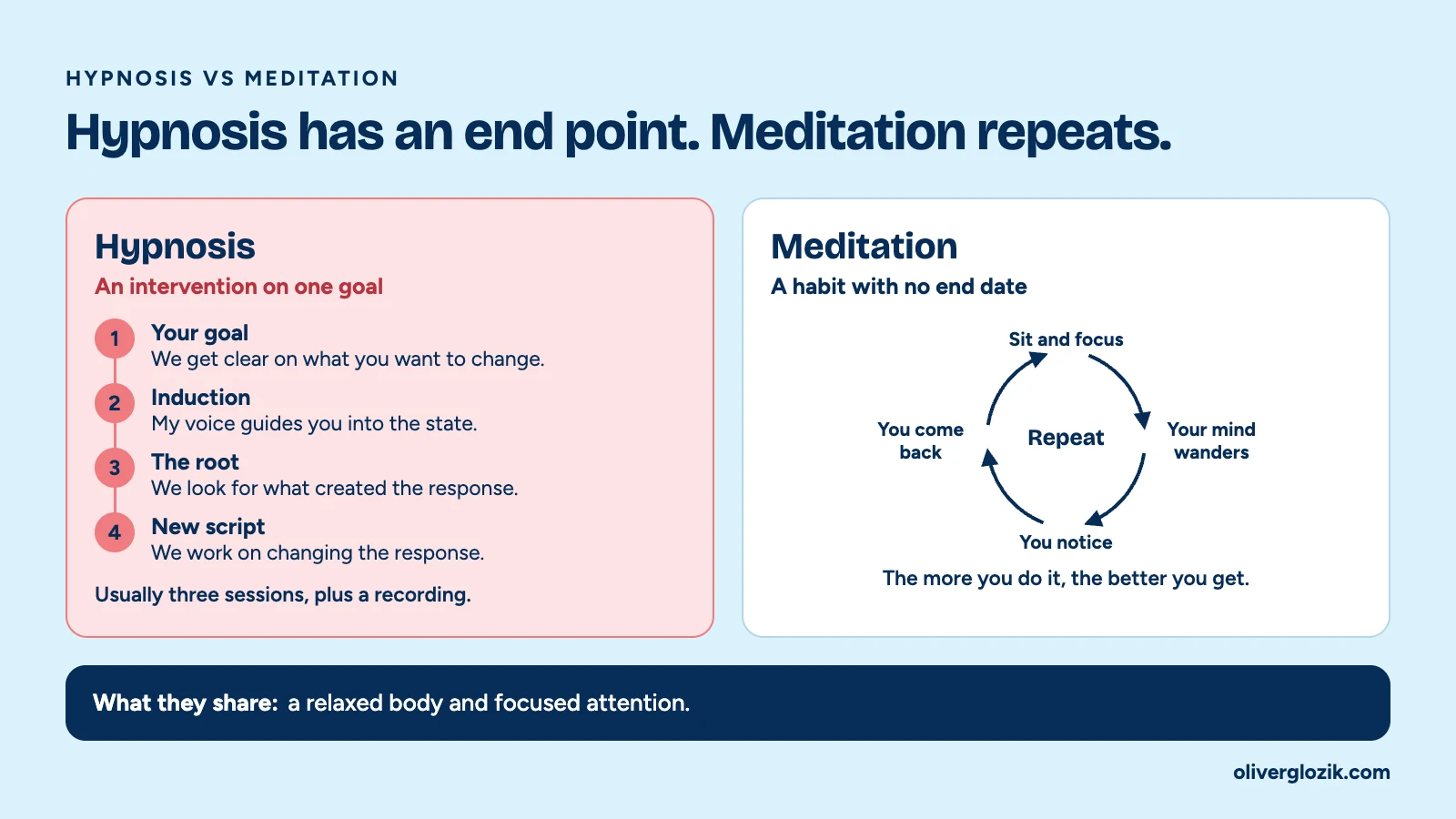
Hypnosis works on a specific goal through suggestion. Meditation trains a general skill through repetition.
The way I see it, meditation is a spiritual practice, although many people now learn it in secular mindfulness courses. You do it to create some distance between an outside impulse and your inner reaction, so you can choose how you respond. It is like training a muscle: the more you do it, the better you get.
Hypnosis, for me, means specific sessions with a clear goal. People come to me because they feel anxiety, because they want to stop overworking, or because they sense a subconscious barrier in their life. In hypnosis we look for the memories that created that response in the first place, and then we work on changing the response. I usually do three sessions, and you also get a recording to listen to morning and evening. I have seen people get big benefits from those few sessions. That is my experience from practice, and I found no study comparing how fast the two work.
“I see meditation as a consistent spiritual practice to create distance from an impulse and one’s emotional response. Hypnosis is an intervention method, to look into the subconscious and start rewiring the script that is creating our reality.”
 Oliver GlozikHypnotist, breathwork facilitator and coach
The official definition of hypnosis describes focused attention, less awareness of your surroundings and an enhanced capacity to respond to suggestion (Elkins et al., 2015). The Trento review adds another difference. Your response to hypnosis depends mainly on your hypnotisability, a trait that stays fairly stable. Meditative skills, they write, “can be developed with practice”.
Researchers disagree on how far apart the two are. Rebecca Semmens-Wheeler and Zoltan Dienes argue that hypnosis makes you less aware of your own intentions and mindfulness makes you more aware of them (2012), while Michael Lifshitz and Amir Raz stress the overlap (2012). Less awareness of your intentions does not mean you lose your choice, as I explain in will I lose control during hypnosis.
When meditation feels impossible
If your thoughts get louder when you close your eyes, you are doing nothing wrong. Many overthinking minds start this way.
This was my own story. The first time I meditated, I found it very hard. With a Western overthinking mind, closing your eyes can bring even more overthinking, and then you think you did something wrong. People expect it to be easy: you just sit down and close your eyes. I find it very challenging. It is a process, and it gets easier the more you do it. Guided meditations make it a bit easier too.
In many ways, I don’t even think meditation is a good starting point for a spiritual practice. I find breathwork much more suitable for beginners, because it gives your mind a job.
If you stay with meditation, the practice is to start watching your thinking. A thought is like a cloud passing by. Thoughts are impulses that come and go, and you are not your thoughts. Once you stop identifying with each one, you stop fighting them.
How hypnosis and meditation feel from the inside
In guided hypnosis you follow a voice, while in silent meditation you are alone with your attention.
This difference matters most for beginners. In hypnosis you focus on my voice and follow the instructions. A good hypnotist can also direct compulsive thinking, because there are ways to quiet it. For most people that makes it easier to reach what I call relaxed concentration.
Small studies describe a similar contrast. One study comparing Transcendental Meditation with recorded hypnosis reported more vivid imagery and less attention to the surroundings in hypnosis, and slower breathing in meditation. Another study found that self-hypnosis brought more self-referential thinking and intense emotion, while meditation began with managing distractions and moved towards body awareness. Both are older studies, reviewed by Penazzi & De Pisapia.
In my own life, when I sit in silence, I prefer self-hypnosis over meditation. It simply works better for me. Everybody is different, so I’d try both.
Is guided meditation the same as hypnosis?
Guided meditation is the closest thing to hypnosis, and the line can blur. For me, the biggest difference is the induction.
In guided hypnosis, the induction is a deliberate set of steps that brings you into the hypnotic state. Then come the suggestions, aimed at the change you came for. I don’t feel guided meditation is as focused on getting you into that state. It usually asks you to be present, and it doesn’t work on one specific pattern from your past.
A guided meditation app or a general hypnosis track can still relax you. The difference grows when a session is built around your problem, which is how I work in a hypnosis session.
Does hypnosis put you in a theta state?
Theta brain waves have been linked to hypnosis, but “theta state” oversimplifies the science, and meditation shows them too.
I have described hypnosis as a theta state myself. A 2015 review did link hypnosis most closely to theta power and changes in gamma activity, but its authors say more research is needed to show whether theta helps hypnosis happen or only reflects it (Jensen et al., 2015). Mindfulness shows the same band: across 56 EEG studies, the most common pattern was higher alpha and theta power, although not every study found it (Lomas et al., 2015). So theta can’t be what separates the two practices. The difference I can point to is in the method: the induction and the suggestions.
Hypnosis vs meditation in the research
The direct comparisons show no clear winner, and most are small.
- The largest trial: 328 US veterans with chronic pain had eight group sessions of hypnosis, mindfulness meditation or pain education. Hypnosis and mindfulness never differed significantly. At six months, both held up better than education on pain intensity and on how much pain interfered with life. Hypnosis also beat education on depressive symptoms (Williams et al., 2022).
- Lab studies of pain: one found lower reported pain after hypnosis than after brief mindfulness. Another, using a single recorded session, found that the two didn’t differ in how well people tolerated cold water (reviewed by Penazzi & De Pisapia, 2022).
- Meditation alone: a review of 47 trials with 3,515 people found moderate evidence for anxiety, depression and pain. The effects were modest, and the evidence for sleep and attention was low or insufficient (Goyal et al., 2014).
- Hypnosis alone: a review of 49 meta-analyses found the strongest evidence for medical procedures and pain. Effects ranged from none to large, and only nine of the 49 were rated high quality (Rosendahl et al., 2024).
These studies don’t tell you which practice is better for your anxiety or your overworking. For that question there is little direct evidence, and I give you my experience below.
Which one should you choose?
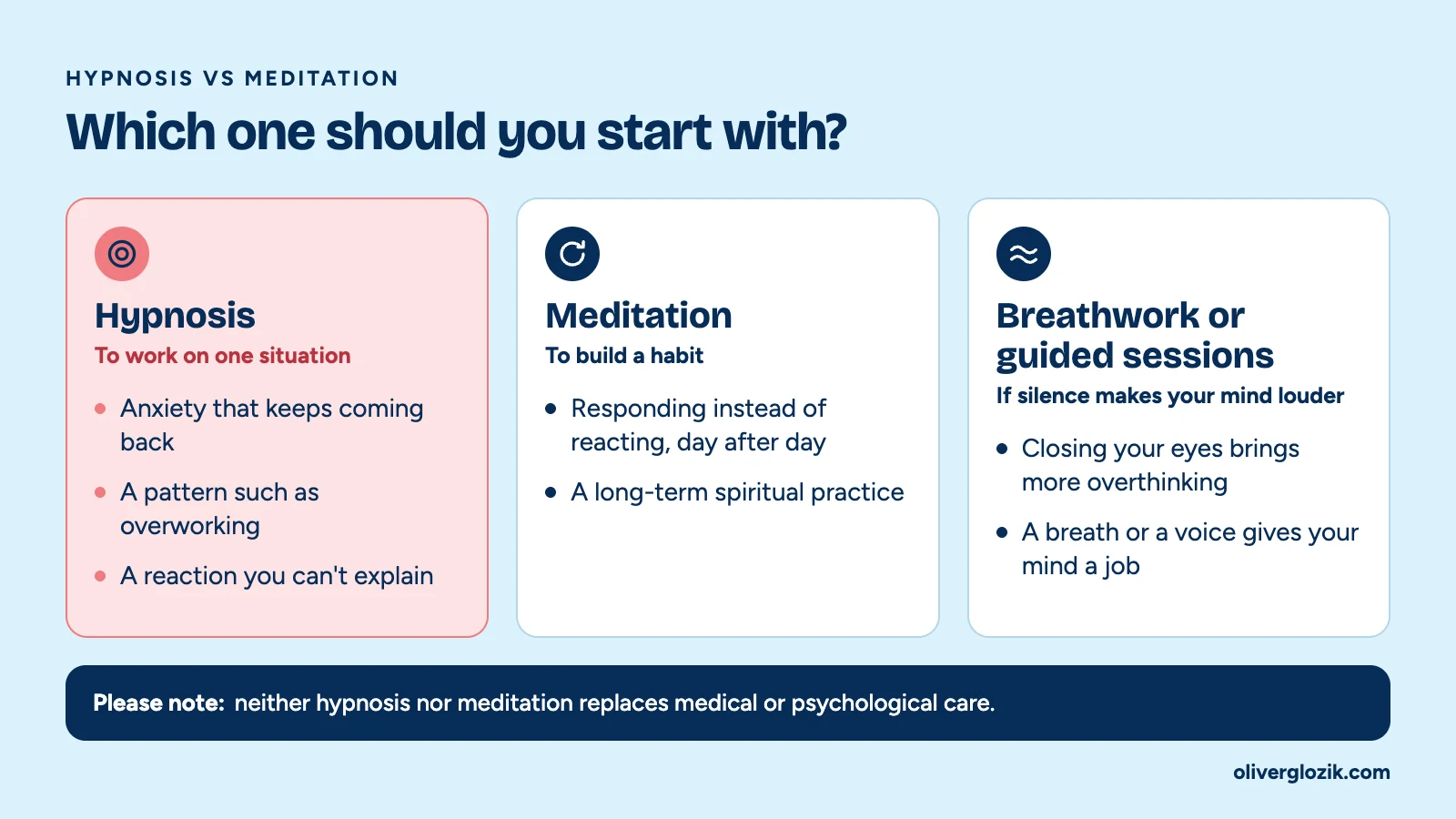
Choose hypnosis to work on a specific situation, and meditation to build a habit.
For anxiety that keeps coming back, a pattern such as overworking or a reaction you can’t explain, I would start with hypnosis. To learn to respond instead of react, or to build a long-term spiritual practice, I would start with meditation. If sitting in silence makes your mind louder, I would start with breathwork or guided sessions.
Please weigh this with two things in mind. I offer hypnosis sessions for a living, and the stronger evidence on anxiety in this article is on the meditation side. My advice to start with hypnosis comes from my own practice, and no trial I found tests it.
You don’t have to pick one forever. A session can work on one problem while a daily practice builds your calm. The veterans trial did not test the two together, and its authors say that question needs more research.
Is hypnosis or meditation unsafe for anyone?
Both are safe for most people, and neither replaces medical or psychological care. Each can also bring up difficult feelings.
Meditation is often presented as harmless, but it can have side effects too. Researchers interviewed 96 people who had done eight-week mindfulness programmes. 58% reported at least one adverse effect, 37% had one that affected their daily functioning, and 6% had effects lasting more than a month (Britton et al., 2021). According to Brown University, the researchers say these rates are similar to other psychological treatments. If meditating leaves you anxious, numb or disconnected, stop and talk to a teacher or therapist who knows about this.
Hypnosis has much less data. A 2018 analysis of registered trials found no serious adverse event attributed to hypnosis, and other adverse events in 0.47% of 429 participants. In a larger overview, 28 of 49 reviews gave no safety information at all, and the reported problems included slight dizziness after a first session and one person who dropped out after a panic attack during a session (Rosendahl et al., 2024).
An older review by John Gruzelier paints a different picture. It calls adverse effects common and mostly short-lived, with reactions such as headache and anxiety. It also describes rarer, serious reactions from case reports, including trauma memories coming back, typically with age regression (Gruzelier, 2000). Because I work with old memories, I keep guiding you if something hard comes up, and you can always ask me to slow down or stop. Tell me too if you get a headache or feel anxious afterwards.
The meditation and hypnosis figures can’t be compared. Britton’s team interviewed each person with 44 questions and found that a single open question missed about 70% of the effects, while most hypnosis trials did not look this closely. So I would not call either practice the safer one. If you have a history of psychosis, schizophrenia, bipolar disorder or epilepsy, please talk to me before you book. If you are in therapy, tell your therapist. If you are in crisis, contact your local emergency services.
Questions about hypnosis and meditation
Which is better, meditation or hypnosis?
Neither won in the direct comparisons so far, and those are mostly small or focused on pain. I’d use hypnosis for a specific problem and meditation as a long-term habit.
Is meditation a form of self-hypnosis?
Not in the way I work. Self-hypnosis has a suggestion or a goal in it, and you guide yourself in with an induction. Meditation asks you to observe whatever comes up. Researchers still debate how much the two overlap.
Does meditating make you better at hypnosis?
There is no good evidence for it. Short meditation training didn’t make people more responsive to hypnosis, and one study found experienced meditators were less suggestible than a large comparison group (reviewed by Penazzi & De Pisapia, 2022). Those studies don’t show whether meditators get less benefit from a session.
Can I do hypnosis if I can’t meditate?
Yes. Hypnosis doesn’t ask you to quiet your mind on your own, because you follow a voice. You can read more in what is hypnosis, or see how a session with me works.
References
- Penazzi, G. & De Pisapia, N. (2022). Direct comparisons between hypnosis and meditation: a mini-review. Frontiers in Psychology, 13, 958185. https://doi.org/10.3389/fpsyg.2022.958185
- Elkins, G. R., Barabasz, A. F., Council, J. R. & Spiegel, D. (2015). Advancing research and practice: the revised APA Division 30 definition of hypnosis. International Journal of Clinical and Experimental Hypnosis, 63(1). https://doi.org/10.1080/00207144.2014.961870
- Semmens-Wheeler, R. & Dienes, Z. (2012). The contrasting role of higher order awareness in hypnosis and meditation. Journal of Mind-Body Regulation, 2(1), 43 to 57. https://journalhosting.ucalgary.ca/index.php/mbr/article/view/16001
- Lifshitz, M. & Raz, A. (2012). Hypnosis and meditation: vehicles of attention and suggestion. Journal of Mind-Body Regulation, 2(1). https://journalhosting.ucalgary.ca/index.php/mbr/article/view/16007
- Jensen, M. P., Adachi, T. & Hakimian, S. (2015). Brain oscillations, hypnosis, and hypnotizability. American Journal of Clinical Hypnosis. https://pmc.ncbi.nlm.nih.gov/articles/PMC4361031
- Lomas, T., Ivtzan, I. & Fu, C. H. Y. (2015). A systematic review of the neurophysiology of mindfulness on EEG oscillations. Neuroscience & Biobehavioral Reviews, 57, 401 to 410. https://repository.uel.ac.uk/item/85464
- Williams, R. M. et al. (2022). Effects of hypnosis vs mindfulness meditation vs education on chronic pain intensity and secondary outcomes in veterans: a randomized clinical trial. Pain, 163(10), 1905 to 1918. https://doi.org/10.1097/j.pain.0000000000002586
- Goyal, M. et al. (2014). Meditation programs for psychological stress and well-being: a systematic review and meta-analysis. JAMA Internal Medicine. https://doi.org/10.1001/jamainternmed.2013.13018
- Rosendahl, J., Alldredge, C. T. & Haddenhorst, A. (2024). Meta-analytic evidence on the efficacy of hypnosis for mental and somatic health issues: a 20-year perspective. Frontiers in Psychology, 14. https://doi.org/10.3389/fpsyg.2023.1330238
- Britton, W. B. et al. (2021). Defining and measuring meditation-related adverse effects in mindfulness-based programs. Clinical Psychological Science. https://doi.org/10.1177/2167702621996340
- Gruzelier, J. (2000). Unwanted effects of hypnosis: a review of the evidence and its implications. Contemporary Hypnosis, 17(4), 163 to 193. https://doi.org/10.1002/ch.207
Want to try it for yourself?
See how my hypnosis sessions work, or book a free call and ask me anything first.