What Is Hypnosis? What Actually Happens in Your Mind
By Oliver Glozik ·
What is hypnosis? It is a natural state of focused attention in which the critical, analysing part of your mind gets quieter and your subconscious becomes more open to suggestion. You are not asleep, and nobody takes control of you. You hear everything, you remember it, and you can open your eyes whenever you want. You also already pass through this state every day: when you wake up, when you fall asleep, and when you drive home without remembering the road. What makes hypnosis useful is that you go into this state on purpose and point it at the pattern you want to change. Hospitals even use it: by 2007, a university hospital in Belgium had done surgery on more than 5,000 patients using hypnosis instead of general anaesthesia.
What is hypnosis? The definition researchers use
Researchers define hypnosis as a state of focused attention and reduced awareness of your surroundings, with a higher capacity to respond to suggestion. That is the wording the hypnosis division of the American Psychological Association agreed on in 2014 (Elkins et al., 2015).
There are three parts in it:
- Focused attention. Your mind narrows onto one thing, like my voice or a picture in your mind.
- Less awareness of everything else. The room, the chair, the to-do list, all of it moves into the background.
- More open to suggestion. An idea your critical mind would normally argue with gets a fair chance.
The same group defines hypnotherapy as using hypnosis to help with a medical or psychological problem.
Key points: what is hypnosis?
- What is hypnosis? A natural state of focused attention where the critical mind gets quieter and you become more open to suggestion.
- You stay aware and in control, and you already pass through this state every day.
- Brain scans show it is its own brain state, and hospitals use it for surgery.
- In a session we go to the subconscious program behind a pattern and change it there.
- The change also needs you: an open mind going in, and the homework afterwards.
You already go into hypnosis every day
Hypnosis is an everyday state, not something exotic. Think about driving a route you know well. You don’t remember exactly when you took the left turn or the right turn. You don’t remember the colour of the car that passed you. And still you arrive from A to B. Your attention was somewhere else, and a program was driving the car.
The moments right after you wake up and right before you fall asleep are similar. The mind is open and impressionable in those moments, and many people waste them by looking at their phone first thing in the morning and last thing at night.
How does hypnosis work?
Hypnosis works by bringing down the volume of the critical mind, so we can go directly to the programming in your subconscious and change it there.
In the same way you drive from A to B without noticing, there is also a roadmap within yourself for how you arrive at the results of your life. And most likely you are aware that you keep on producing very similar results, over and over again. That blueprint was mostly written in childhood. Often it was even random or superficial situations that we internalised and gave a meaning to: I’m not worthy, I’m not good enough. Those moments still dictate so much of the blueprint, and for most people that blueprint is outdated.
When you talk about a pattern, you are talking with the logical mind. It can understand everything and still the pattern stays. Hypnosis is less about understanding the pattern and more about going past the critical mind to where the program actually sits.
What happens in the brain during hypnosis
Brain scans show that hypnosis is its own brain state, not just relaxation or people playing along. In 2016 a Stanford team led by David Spiegel scanned 57 people who were either very easy or very hard to hypnotise (Jiang et al., 2016). In the easy group, and only while they were in hypnosis, three things changed:
- Activity went down in the dorsal anterior cingulate cortex, a part of the brain that keeps you alert to what is happening around you.
- The connection got stronger between the prefrontal cortex and the insula, which keeps track of what is going on in your body.
- The connection got weaker between the prefrontal cortex and the default mode network, which is active when you think about yourself.
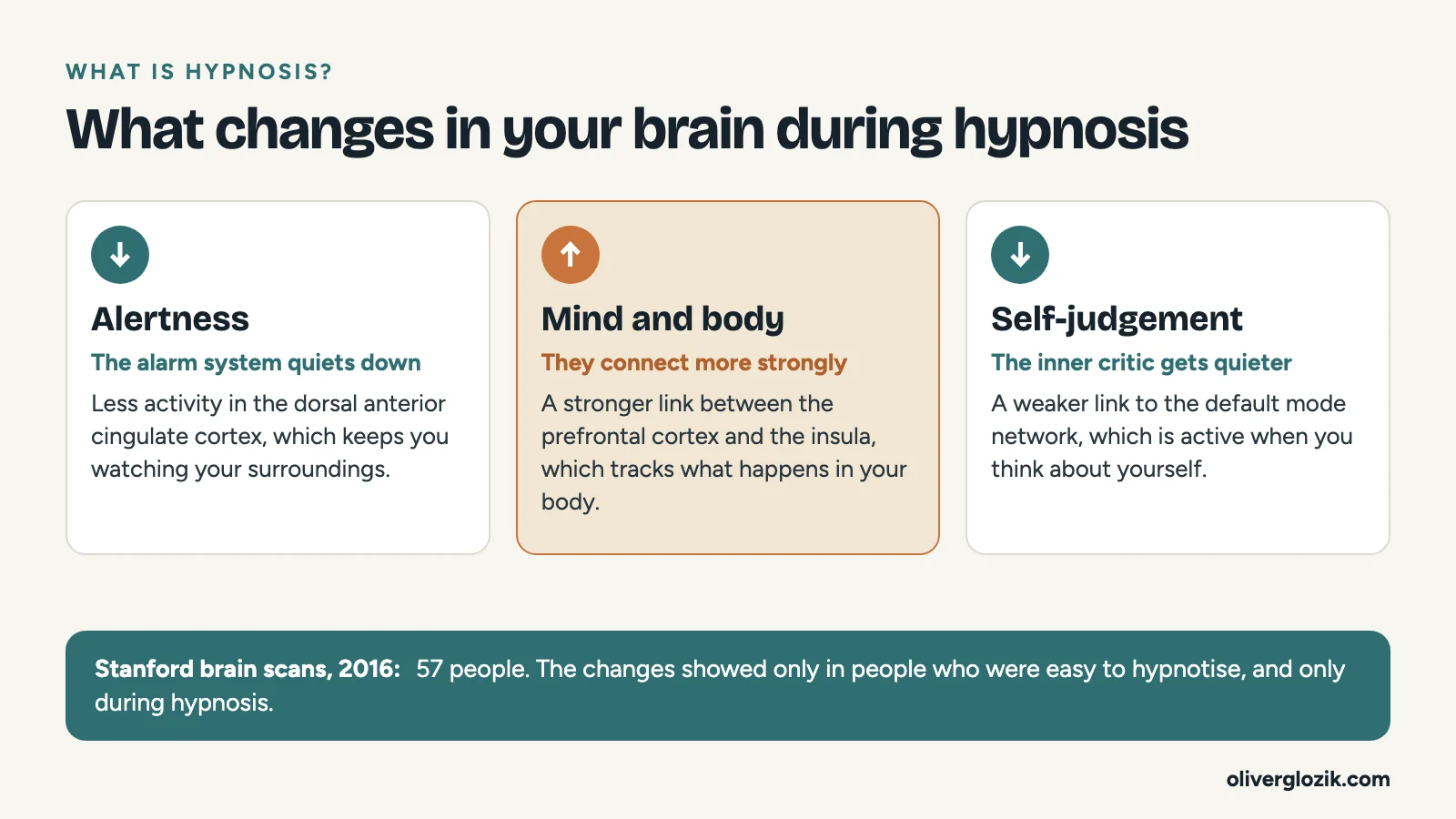
In simple words: less watching out for danger, more connection between mind and body, and less of the voice that observes and judges yourself. It is one study with a small and selected group, so it needs to be repeated. But it fits very well with what people describe.
Is hypnosis real?
Yes, hypnosis is real. It is used in hospitals and by dentists, and it has been studied in controlled trials for decades.
When I start a hypnosis session, one of the first things I ask is, “What is your association with hypnosis?” It is important for me to know where people are at. Most people think of show hypnosis: people forgetting their names, sometimes making a fool of themselves, not being in control. And I say, yes, of course, that entertainment exists. But for me it also shows how powerful of a method it is.
Then I like to give an extreme example. At the University Hospital of Liège in Belgium, the anaesthesiologist Marie-Elisabeth Faymonville started in 1992 to combine hypnosis with local anaesthetic and very light sedation, instead of putting people fully under. By 2007 more than 5,350 patients had been operated on this way, in thyroid surgery, plastic surgery and other areas (Faymonville et al., 2007). Some dentists are also trained in hypnosis.
“Hypnosis is a powerful tool that is even used in hospitals instead of general anaesthesia. If that is possible, think about other ways hypnosis could benefit your life, by starting to rewrite the subconscious patterns that create your reality.”
 Oliver GlozikHypnotist, breathwork facilitator and coach
The idea is also not new. In the 1770s Franz Mesmer claimed he could heal people with “animal magnetism”. In 1784 a French royal commission, with Benjamin Franklin as one of its members, tested it (the commission’s report) and concluded that the effects came from the patients’ imagination. In 1843 the Scottish surgeon James Braid called the state “hypnotism” in his book Neurypnology, from the Greek word for sleep. Later he regretted the name, because he understood it is not sleep at all.
What happens in a hypnosis session
In a session I guide you into hypnosis, and then I ask your subconscious the few questions that have the most impact on your problem.
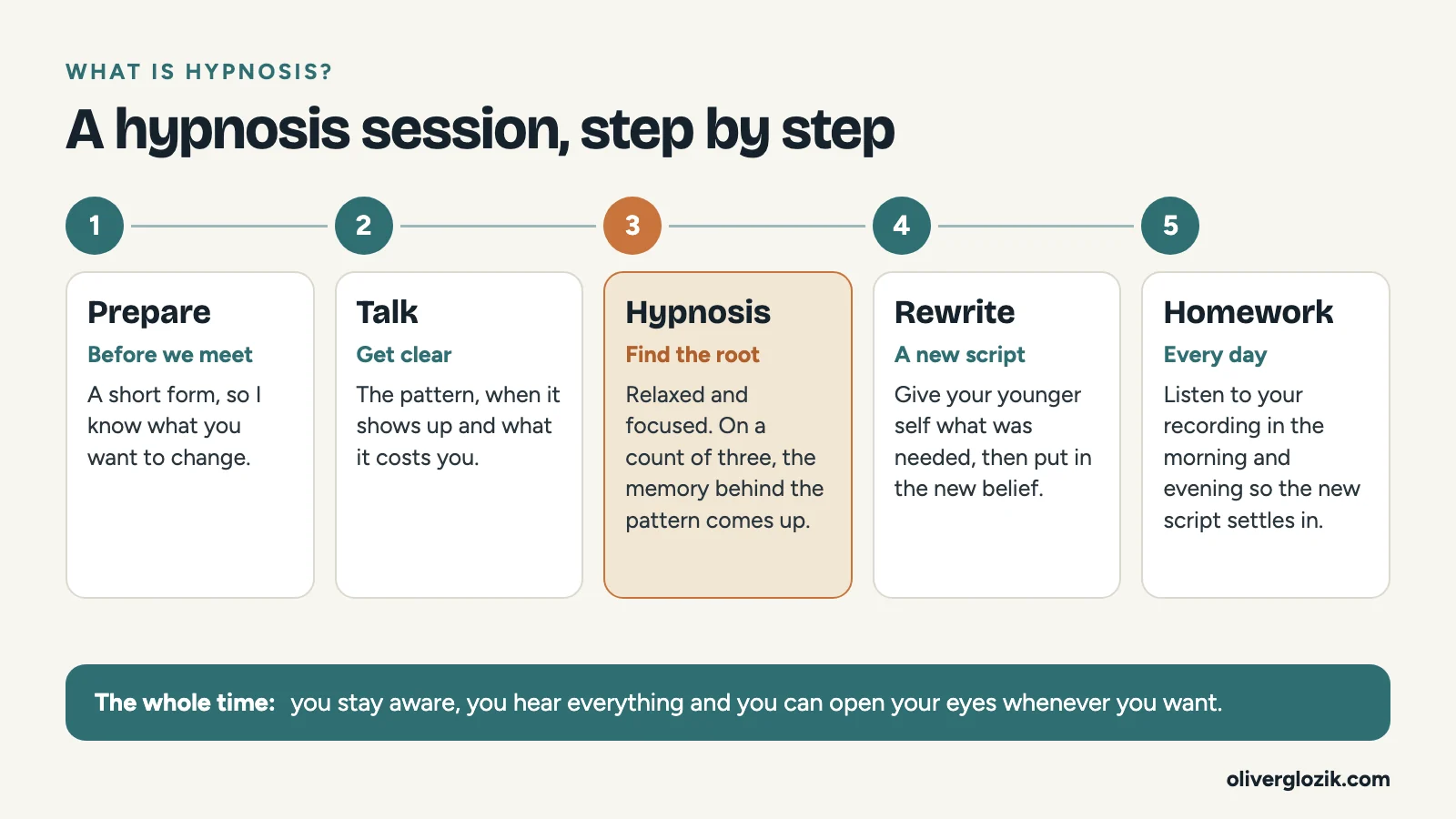
A recent example. A man came to me to explore his money blockage. Once he was in hypnosis I said, “On the count of three, a memory is going to come up that created this money blockage for you.” What came up was a happy childhood that changed when his dad started to become successful. His dad started to use money as a form of control, and that is when the distance came into the family.
So subconsciously he connected it like this: if I make money, I turn into a bad person, I lose happiness, I lose love, money is a tool for control. Deep within himself he didn’t want to become wealthy, because becoming wealthy meant becoming a bad person. None of this was conscious for him before. He was not aware this was his money pattern, or where it came from.
After a memory like this comes up, we also go back into it. I say, “Hey, now go back to that memory and give yourself what you needed in that moment.” By doing that, the memory starts to change, and it no longer dictates your life in the same way. To be able in a session to go to the core of a topic, address it and reprogram it, that is what I find so powerful about hypnosis.
After the session you also get a recording. The homework is to listen to it in the morning and in the evening before you go to sleep, and by doing that on a continuous basis, you anchor the new reality into your life.
Hypnosis, breathwork and ceremony compared
Hypnosis, breathwork and ceremony have a big overlap: in all three the logical, critical mind is reduced. The difference is the level of direction.
| Hypnosis | Breathwork | Ceremony | |
|---|---|---|---|
| Critical mind | Quieter | Quieter | Quieter |
| Who sets the direction | The hypnotist guides you to a specific memory or belief | Your subconscious brings up what is most present | Your subconscious brings up what is most present |
| Strong for | One chosen topic, worked on precisely | Calming the mind and reaching emotions in the body | Deep and wide inner work |
You can go into a breathwork session and say, “Okay, I want to overcome my money blockage.” And maybe something totally unrelated comes up, because it is more in the front of your subconscious mind. It is very similar in a ceremony. With hypnosis, a good hypnotist can guide you to exactly the pain points, to exactly the places that created the programming to begin with, and start shifting them there.
For me, all the work I did before with breathwork and ceremony has had a big impact on how I work with hypnosis. That level of direction and that level of certainty you need as a hypnotist, I learned a lot of it there.
Can everyone be hypnotized?
Most people can be hypnotized, but some people respond more strongly than others. Researchers call this hypnotisability. A minority respond very strongly, a minority hardly respond, and most people are somewhere in the middle. It is also quite stable over a lifetime: one study tested people again after 25 years and found very similar scores (Piccione et al., 1989).
But your attitude matters as much. My own first official meeting with hypnosis was about nine years ago at an NLP seminar. The hypnotist said he could make people unable to move their hands, and I said, “Well, I don’t think that’s going to work.” He said, “If you don’t think it’s going to work, then it’s not going to work either.” In the end we never did it. Some time later I followed a hypnosis on a webinar, with an open mind. Afterwards I had a high level of energy, a high level of clarity on my next steps, and a level of urgency to start acting on them sooner rather than later.
So it can be that you are naturally very suggestible. It can also be that you are creative and can visualise easily, and then you often go deeper. And it can also be that you close yourself off by deciding beforehand that it is stupid and won’t work. Then you are creating the barrier yourself. The experience and the concentration of the hypnotist also make a big difference.
Does hypnosis work? What the research says
Hypnosis does work for several problems, and the evidence is strongest for medical procedures and pain. A 2024 review brought together 49 meta-analyses covering 261 studies and found the most robust evidence for hypnosis during medical procedures and for pain, with the largest effects in pain, medical procedures and children and teenagers (Rosendahl et al., 2024). In the UK, the NICE guideline on IBS says doctors should consider hypnotherapy when symptoms have not improved with medication after 12 months.
For quitting smoking the results were mixed, and for many areas the authors point out that the effects rest on only a small number of studies. And I want to be honest: using hypnosis to change beliefs and patterns, the way I use it, has been studied less than pain or IBS. What I can tell you is what I see in sessions, like the example above.
Is hypnosis safe?
Hypnosis is safe for most people. You stay aware the whole time, and you can stop whenever you want.
It is not right for everybody, though. If you have a history of psychosis, schizophrenia, bipolar disorder or epilepsy, please talk to me before you book. Hypnosis is not a replacement for medical or psychological care. If you are in therapy, it can be a good complement, so tell your therapist you are doing it. If you are in crisis, contact your local emergency services.
If you want to feel what it is like for yourself, have a look at how a hypnosis session with me works. I wish you all the best with it.
Questions about hypnosis
What does hypnosis feel like?
Most people describe it as deep relaxation with a clear, focused mind. You hear everything, and many people are surprised how aware they stay.
Will I lose control under hypnosis?
No. You can speak, move or open your eyes at any time, and you keep your own judgement the whole time.
Is hypnosis the same as hypnotherapy?
Hypnosis is the state itself. Hypnotherapy is using that state to help with a specific problem.
Can I get stuck in hypnosis?
No. If the hypnotist stopped talking, you would simply come out of it by yourself, or drift into normal sleep and wake up as usual.
How long is a hypnosis session?
My sessions take between an hour and an hour and a half, depending on what comes up. Afterwards you get a recording to listen to in the morning and before you sleep, so the new script keeps settling in.
References
- Elkins, G. R., Barabasz, A. F., Council, J. R. & Spiegel, D. (2015). Advancing research and practice: the revised APA Division 30 definition of hypnosis. International Journal of Clinical and Experimental Hypnosis, 63(1). https://doi.org/10.1080/00207144.2014.961870
- Jiang, H., White, M. P., Greicius, M. D., Waelde, L. C. & Spiegel, D. (2016). Brain activity and functional connectivity associated with hypnosis. Cerebral Cortex. https://doi.org/10.1093/cercor/bhw220
- Faymonville, M. E. et al. (2007). Revue Médicale de Liège, 62 (supplement 1). https://rmlg.uliege.be/download/1522/827/M.E.-Faymonville_2007_62_S1_0.pdf
- Piccione, C., Hilgard, E. R. & Zimbardo, P. G. (1989). On the degree of stability of measured hypnotizability over a 25-year period. Journal of Personality and Social Psychology, 56(2), 289 to 295. https://doi.org/10.1037/0022-3514.56.2.289
- Rosendahl, J., Alldredge, C. T. & Haddenhorst, A. (2024). Meta-analytic evidence on the efficacy of hypnosis for mental and somatic health issues: a 20-year perspective. Frontiers in Psychology, 14. https://doi.org/10.3389/fpsyg.2023.1330238
- Bailly, J.-S. et al. (1784). Report of the commissioners charged by the King with the examination of animal magnetism. English translation in International Journal of Clinical and Experimental Hypnosis, 50(4), 2002. https://doi.org/10.1080/00207140208410109
- Braid, J. (1843). Neurypnology; or, the Rationale of Nervous Sleep. London: John Churchill.
- National Institute for Health and Care Excellence (2008, updated 2017). Irritable bowel syndrome in adults: diagnosis and management (CG61). https://www.nice.org.uk/guidance/cg61
Want to try it for yourself?
See how my hypnosis sessions work, or book a free call and ask me anything first.